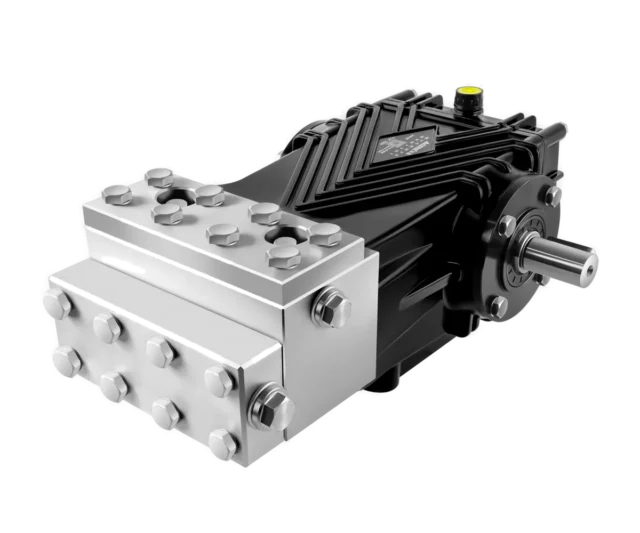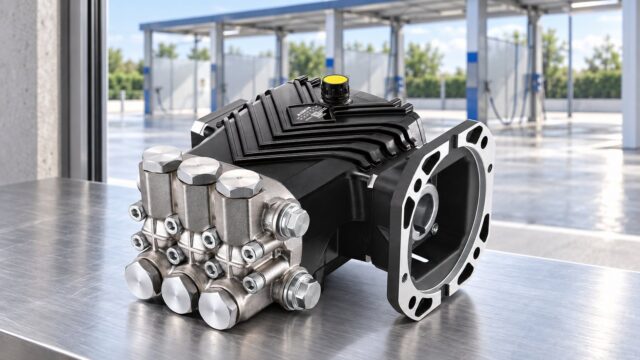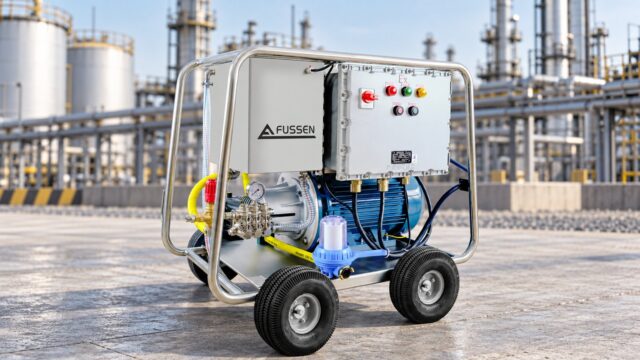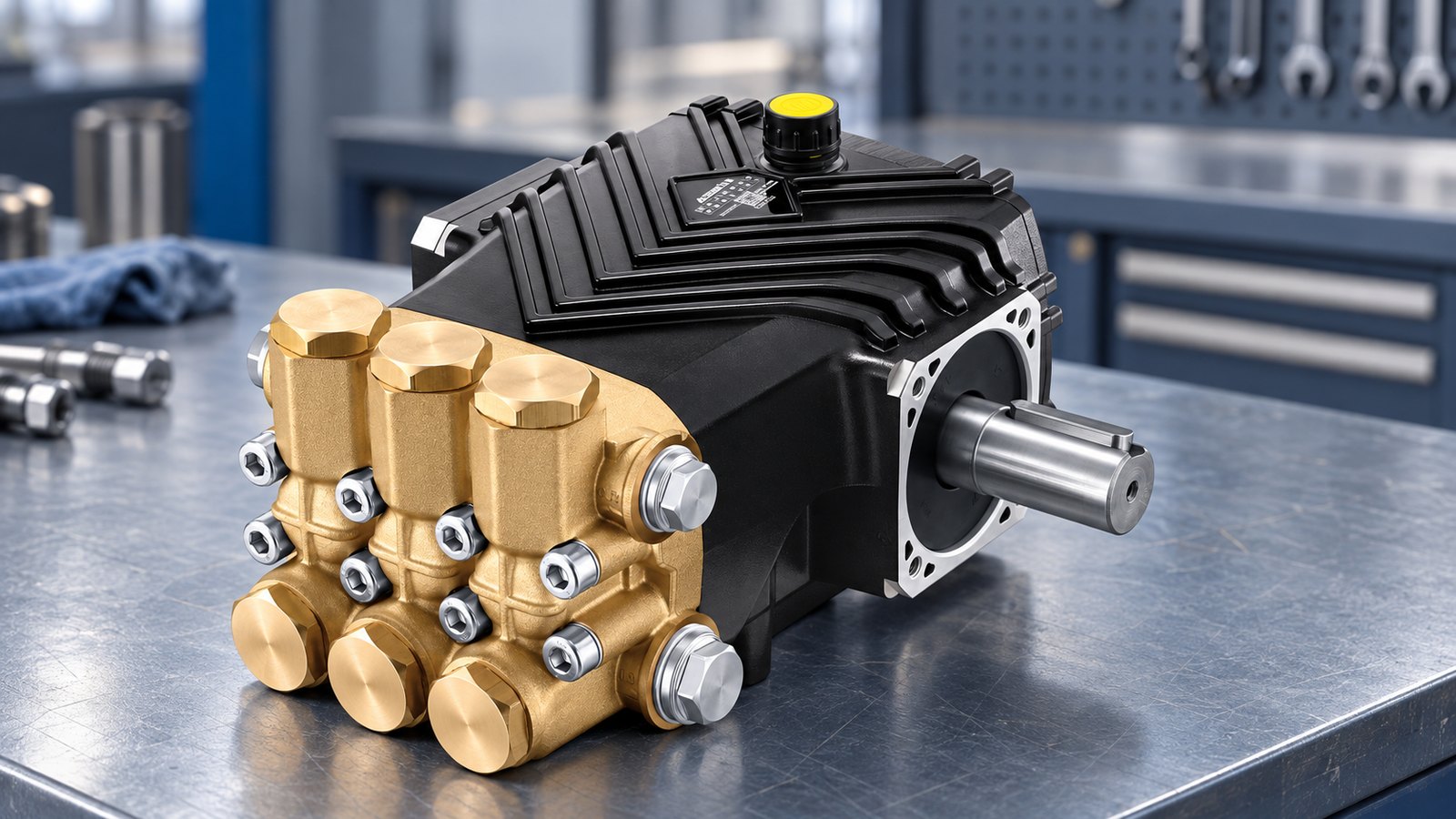
Ask a maintenance engineer why one high pressure unit runs for years with little more than oil changes while another needs new seals every season, and the answer is almost always in the pump itself. The triplex plunger pump is the standard power end for industrial pressure washers, water jetting units and reverse osmosis skids: three plungers driven 120 degrees apart deliver a nearly constant flow, the plungers do not drag the pressure seals along a cylinder wall the way a piston does, and the valves are simple check valves serviced in minutes. But the name covers a wide range of build quality. This article walks through the mechanism part by part, from crankshaft to outlet valve, explains what ceramic plungers and rubber-coated fabric seals actually do, shows how to calculate flow from plunger geometry, and gives the numbers behind Fussen’s A to E series so you can match a pump to a duty rather than guess.
What a Triplex Plunger Pump Is and Why It Dominates High Pressure Work
A plunger pump is a positive displacement machine. Every revolution moves a fixed volume of water regardless of pressure; pressure is created only by downstream resistance, which is the nozzle. Flow is set by the pump, pressure by the nozzle, and a blocked outlet with no relief valve raises pressure until something breaks.
“Triplex” means three plungers. Compared with a single plunger, three cylinders phased at 120 degrees overlap their discharge strokes so that total flow never falls to zero. A triplex is also more compact and has fewer valves than a five-plunger pump, which makes it the default for 10 to 200 L/min at 100 to 2,000 bar.
The distinction from a piston pump matters: a piston carries its seal and slides it along the cylinder wall under full pressure, whereas a plunger pump keeps the seals stationary in the head and moves a smooth, hard plunger through them. Stationary seals plus a ceramic plunger surface is the combination that makes long service intervals possible.
Inside the Crankcase: Crankshaft, Connecting Rods and Crossheads
The power end converts rotary motion into reciprocating motion. Fussen pumps use a forged crankshaft in roller or ball bearings, with three eccentric journals offset by 120 degrees. Solid shaft diameters run from 24 mm on the A, B and C series to 30 mm on D, 40 mm on E and 50 or 60 mm on the largest FFS units; the shaft grows with torque, not pressure alone.
From rotation to straight-line motion
Each journal carries a connecting rod whose small end is pinned to a crosshead, a cylindrical slider running in a bore in the crankcase. The crosshead absorbs the side load from the angled rod so that the plunger bolted to its front moves in a pure straight line. Without it, side load would reach the plunger and wear the water seals unevenly.
Two points to check on any pump you evaluate: crosshead guide length, since a longer guide lowers side-load pressure and slows wear, and the connecting rod big end, where bronze or bi-metal shells on a hardened journal are typical for high load units.
Why 120 degree phasing reduces pulsation
The instantaneous flow of a single plunger follows a half-sine curve during the discharge stroke and is zero during the suction stroke. With three plungers 120 degrees apart, at least one plunger is always discharging and for part of each revolution two are. The result is a total flow that varies by roughly plus 6 percent and minus 17 percent around the mean, compared with 100 percent variation for a single-acting simplex. A pulsation damper, or the compliance of 20 to 50 m of hose, smooths the remainder. Pulsation much larger than this at the gun usually means one cylinder is not filling or one valve is not sealing.
The Plunger: Ceramic Versus Alloy Steel
The plunger is the only moving part in contact with the high pressure seals, so its surface finish and hardness decide seal life. Two constructions are common.
| Property | Solid ceramic (alumina) plunger | Alloy steel or hard-chromed plunger |
|---|---|---|
| Surface hardness | Approx. 1,500 to 1,800 HV | Approx. 700 to 1,000 HV (chrome layer) |
| Surface finish after lapping | Ra 0.1 to 0.2 micrometre | Ra 0.2 to 0.4 micrometre |
| Corrosion resistance | Inert to water, seawater and most chemicals | Depends on coating integrity; pitting once chrome cracks |
| Thermal behavior | Low conductivity, stays cool at seal | Conducts heat to seal area |
| Typical use | Standard on all Fussen series | Very high pressure special duties, some low-cost pumps |
Fussen fits solid ceramic plungers as standard, with the ceramic sleeve carried on a stainless steel core that takes the mechanical load. Because ceramic is roughly twice as hard as chrome plating and holds a finer finish, the seals wear more slowly and do not score the plunger; when seals are replaced, the plunger normally goes back into service unchanged. Hard-chromed steel plungers remain a reasonable choice above about 1,500 bar, where ceramic section thickness becomes a limitation.
Water Seals, Oil Seals and Lubrication
Every plunger passes through two sealing groups arranged in series. Understanding the difference explains most leak diagnoses.
High pressure seals
The high pressure group sits closest to the valve chamber and holds full working pressure. Fussen uses rubber-coated fabric seals: layers of woven fabric impregnated with a nitrile or HNBR compound and molded into a V or U profile. The fabric carries the extrusion load, the rubber coating provides the low-friction lip. This construction resists extrusion into the plunger clearance far better than a plain rubber lip seal, which is why it is preferred from 250 bar upwards.
The seals are rated for continuous water temperature up to 65 degrees Celsius. Above that the elastomer softens, friction rises and life drops sharply. Hot water washers that heat after the pump are fine; feeding hot return water into the inlet is not, unless high temperature seals are specified.
Low pressure seals
The low pressure group sits behind it, nearer the crankcase. It seals inlet pressure during the suction stroke and acts as a weep barrier: leakage past the high pressure seals drains through a weep port between the two groups instead of reaching the crankcase. A few drops per minute at the weep port is normal; a steady stream means the high pressure seals are due.
This gap is also where a dry-run failure shows first: with no water the seals run unlubricated, temperature climbs in seconds and the lip is burned, which is why priming before start-up is mandatory.
Oil seals and crankcase lubrication
Where the crosshead enters the crankcase, a lip-type oil seal keeps oil in and water out, and a slinger on the plunger throws off any water that passes the low pressure seal before it can reach the oil seal. The crankcase is splash lubricated: the connecting rods dip into the sump and fling oil onto the crosshead guides and bearings. Practical rules for oil:
- Use the specified grade, typically SAE 30 or ISO VG 100 non-detergent mineral oil, or synthetic gear oil above 40 degrees Celsius ambient.
- Change the first fill after 50 hours, then every 500 hours or 3 months.
- Milky oil means water ingress through a worn oil seal or flooded weep drain. Stop, find the cause, change the oil.
- Oil temperature should sit 30 to 40 degrees Celsius above ambient; higher points to overload, low oil or a bearing issue.
Larger D and E series pumps may add an oil pump and cooler, because splash lubrication alone cannot carry away the heat generated at 40 kW and above.
Inlet and Outlet Check Valves
Each cylinder has one suction and one discharge valve, both spring-loaded check valves with no timing mechanism: they open when the pressure difference overcomes the spring and close when flow reverses. A Fussen valve assembly consists of:
- a 316 stainless steel seat, lapped flat, which resists corrosion and the impact of the valve closing up to 25 times a second;
- a hardened stainless steel valve plate or poppet;
- a stainless spring sized so that the valve closes before the plunger reverses, which prevents backflow and the “knock” of late closure;
- an engineering plastic cage, typically glass-filled PA or POM, that guides the plate and holds the spring. Plastic cages do not corrode and are cheap enough that the whole valve is treated as a cartridge.
Cartridges sit in the head under threaded plugs. On A, B and C series pumps all six valves can be removed with a socket and inspected in under 15 minutes without disturbing the seals. A valve that does not seal shows as a drop in flow and a rise in pulsation; seat and plate are replaced as a pair.
Inlet valves are the more sensitive. They open under only tank head or mains pressure, so a partly blocked filter, a long suction hose or warm water can stop them opening fully. The cylinder fills incompletely and cavitation collapse on the discharge stroke pits the seat and plate.
Pump Head Materials: Brass, Nickel-Plated Brass and Stainless Steel
The manifold, or pump head, houses the seals and valves and takes the full pressure load. Fussen offers three materials and the choice is driven by water chemistry more than pressure.
| Head material | Fussen series examples | Suitable for | Avoid when |
|---|---|---|---|
| Forged brass | FAB, FBB, FCB, FCC, FCR | Clean fresh water, standard pressure washing, general industry | Seawater, chlorides, low pH detergents, deionised water |
| Nickel-plated brass | FAN, FBN, FCN, FCK, FCM | Softened or lightly treated water, mild detergents, food-plant washdown, applications where appearance matters | Abrasive media that will wear through the plating, strong acids |
| Stainless steel (AISI 316 or duplex) | FAS, FBS, FCH, FCL, FDH, FDK, FDL, FEH, FES, FEK, FEL, FFS | Seawater, desalination and RO feed, chemical dosing, hot water, all pressures above 600 bar | Rarely; cost is the only drawback |
Brass is not “worse”: it machines well, conducts heat away from the seals and suits the majority of pressure washing duties, which is why the brass FAB series plunger pump is Fussen’s highest volume model. Above 600 bar the stress in the head makes stainless mandatory, which is why every D and E series pump, such as the FDH 1,000 bar stainless pump, is offered in stainless only.
Calculating Flow, Power and Volumetric Efficiency
A plunger pump’s flow is geometry multiplied by speed. For a triplex:
Q = 3 × (π/4 × d²) × s × n × η
where d is the plunger diameter, s is the stroke, n is the crankshaft speed and η is the volumetric efficiency. Working in millimetres and rpm gives cubic millimetres per minute; divide by 1,000,000 for liters.
Worked example: a plunger of 18 mm diameter, a stroke of 16 mm and a speed of 1,450 rpm.
- Plunger area: π/4 × 18² = 254.5 mm²
- Swept volume per plunger per revolution: 254.5 × 16 = 4,072 mm³
- Three plungers: 12,216 mm³ per revolution, or 12.2 mL
- At 1,450 rpm: 12.2 × 1,450 = 17.7 L/min theoretical
- At η = 0.998: 17.7 L/min delivered
Fussen quotes a volumetric efficiency of around 99.8 percent at rated pressure. The figure is high because water is almost incompressible, the valves close before the plunger reverses and cylinder dead volume is small. A worn valve or leaking seal shows as a fall in η before anything else: if a 17.7 L/min pump delivers 16 L/min at the same speed, you have lost about 10 percent, which points to a valve problem.
Hydraulic power
Once flow and pressure are known, the shaft power is:
P (kW) = Q (L/min) × p (bar) / 600 / ηmech
Taking 17.7 L/min at 250 bar with a mechanical efficiency of 0.9 gives 8.2 kW, which is why an A series pump at 250 bar carries a 7.5 to 9 kW motor, while the same flow at 500 bar in the FCB 500 to 600 bar brass pump needs 15 kW or more.
Speed and life
Flow can be raised by running faster, but seal and valve life fall roughly with speed. Direct coupling at 1,450 rpm (50 Hz) or 1,750 rpm (60 Hz) is the norm for A to C series. D and E series use belt drive or a gearbox to bring the pump down to 600 to 1,000 rpm; the FEK-G gearbox-mounted stainless pump lets a 1,450 rpm motor drive a large plunger at a speed that keeps valve impact and seal rubbing velocity low.
Fussen Series Overview: Matching Pressure and Flow
Fussen’s plunger pump range is organized into five frame sizes, A to E, with the head material shown by the third letter of the model code (B brass, N nickel-plated brass, S or H stainless steel, plus a few series-specific letters). The table gives the working envelope of each frame.
| Frame | Series | Pressure range | Flow range | Shaft | Typical drive |
|---|---|---|---|---|---|
| A | FAB, FABH, FAN, FANH, FAS, FASH | 120 to 250 bar | 10.0 to 21.7 L/min | Solid 24 mm or hollow 28 mm | Direct coupled, 4 to 9 kW |
| B | FBB, FBN, FBS | 200 to 350 bar | 10.0 to 36.2 L/min | Solid 24 mm | Direct coupled, 7.5 to 22 kW |
| C | FCB, FCN, FCH, FCC, FCK, FCR, FCM, FCL | 160 to 600 bar | 15.0 to 84.0 L/min | Solid 24 mm | Direct or belt, 15 to 37 kW |
| D | FDH, FDK, FDL | 100 to 1,000 bar | 15.0 to 150.0 L/min | Solid 30 mm | Belt or gearbox, 30 to 55 kW |
| E | FEH, FES, FEK, FEL, FEK-G, FES-G, FFS, FFS-G | 100 to 2,000 bar | 10.0 to 215.0 L/min | Solid 40, 50 or 60 mm | Gearbox or belt, 45 to 110 kW |
Hollow-shaft A series variants mount directly onto a 28 mm motor shaft. The model number encodes flow and pressure: FAB 1525 is 15 L/min at 250 bar, FBS 3620 is 36 L/min at 200 bar. Because flow and pressure trade against each other at constant power, one frame covers both high pressure, low flow and low pressure, high flow duties; the FBS stainless steel pump spans 10 to 36 L/min within one crankcase.
Why a Well-Built Triplex Plunger Pump Lasts
Longevity comes from a few choices a buyer can verify: stationary seals on a ceramic plunger; crosshead-guided motion that keeps side loads in the oil-filled crankcase; cartridge valves with stainless seats; head material matched to the water; conservative speed, since larger plungers at lower rpm outlast small plungers at high rpm; and a weep drain that announces a leak long before it contaminates the oil.
Under those conditions a Fussen pump on clean, filtered water at rated pressure runs a long time between seal changes, and far longer between valve seat replacements. Poor inlet conditions, water over 65 degrees Celsius or a dry start shorten those figures more than any other factor.
Specifying a pump for a washer build, an OEM skid or a replacement? Contact Fussen with your required flow, pressure, water source and motor speed, and we will return a model recommendation with dimensional drawings.
Frequently asked questions
What is the difference between a triplex plunger pump and a piston pump?
In a piston pump the seal is fitted to the moving piston and slides along the cylinder wall under pressure. In a plunger pump the seals are stationary in the pump head and a smooth ceramic plunger moves through them. Stationary seals on a hard, polished plunger wear far more slowly, which is why plunger pumps are used for continuous duty above about 100 bar.
Why does Fussen use ceramic plungers instead of steel?
Alumina ceramic is roughly twice as hard as hard chrome plating, holds a finer surface finish, does not corrode in seawater or chemicals and conducts little heat to the seals. The result is longer seal life and a plunger that normally goes back into service when the seals are changed. The ceramic sleeve is carried on a stainless steel core that takes the mechanical load.
How much pulsation should a triplex plunger pump produce?
With three plungers 120 degrees apart, theoretical flow varies by about plus 6 percent and minus 17 percent around the mean. A pulsation damper or a long delivery hose smooths most of this. If pulsation at the gun is noticeably worse, suspect a valve that is not sealing or a cylinder that is not filling because of a blocked inlet filter or air in the suction line.
What water temperature can the pump seals tolerate?
Standard rubber-coated fabric seals are rated for continuous water temperature up to 65 degrees Celsius at the pump inlet. Hot water washers heat the water after the pump, so the pump itself stays within this limit. If you need to pump water hotter than 65 degrees Celsius, specify high temperature seals and a stainless steel head.
Which pump head material should I choose: brass, nickel-plated brass or stainless steel?
Use brass for clean fresh water and general pressure washing. Choose nickel-plated brass for softened water, mild detergents and food-plant washdown where corrosion staining must be avoided. Choose stainless steel for seawater, desalination and RO feed, chemical dosing, hot water and every duty above 600 bar, where the head stress requires it.
Need a recommendation?
Get a Quotation and Technical Recommendation Within 24 Hours
Send us your pressure, flow and application. Our engineers reply within 24 hours.

Fussen has designed and manufactured high pressure plunger pumps and industrial washers in Foshan, China since 2001. ISO 9001 / 14001 / 45001, CE and ATEX-certified, exporting to more than 60 countries.