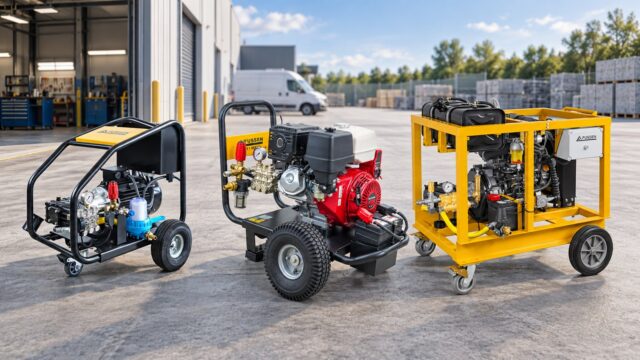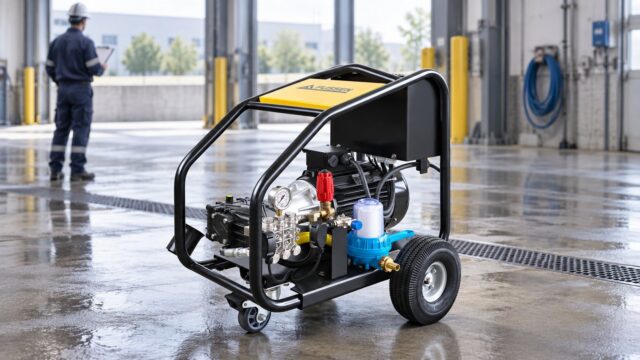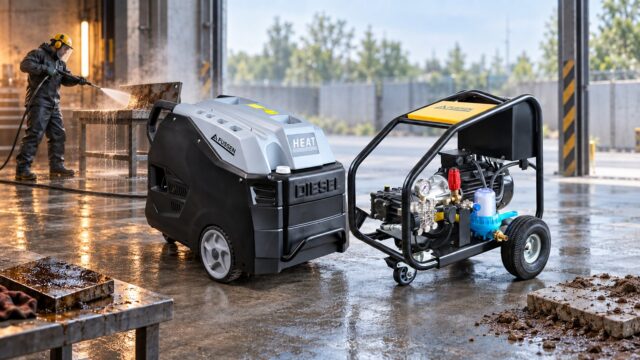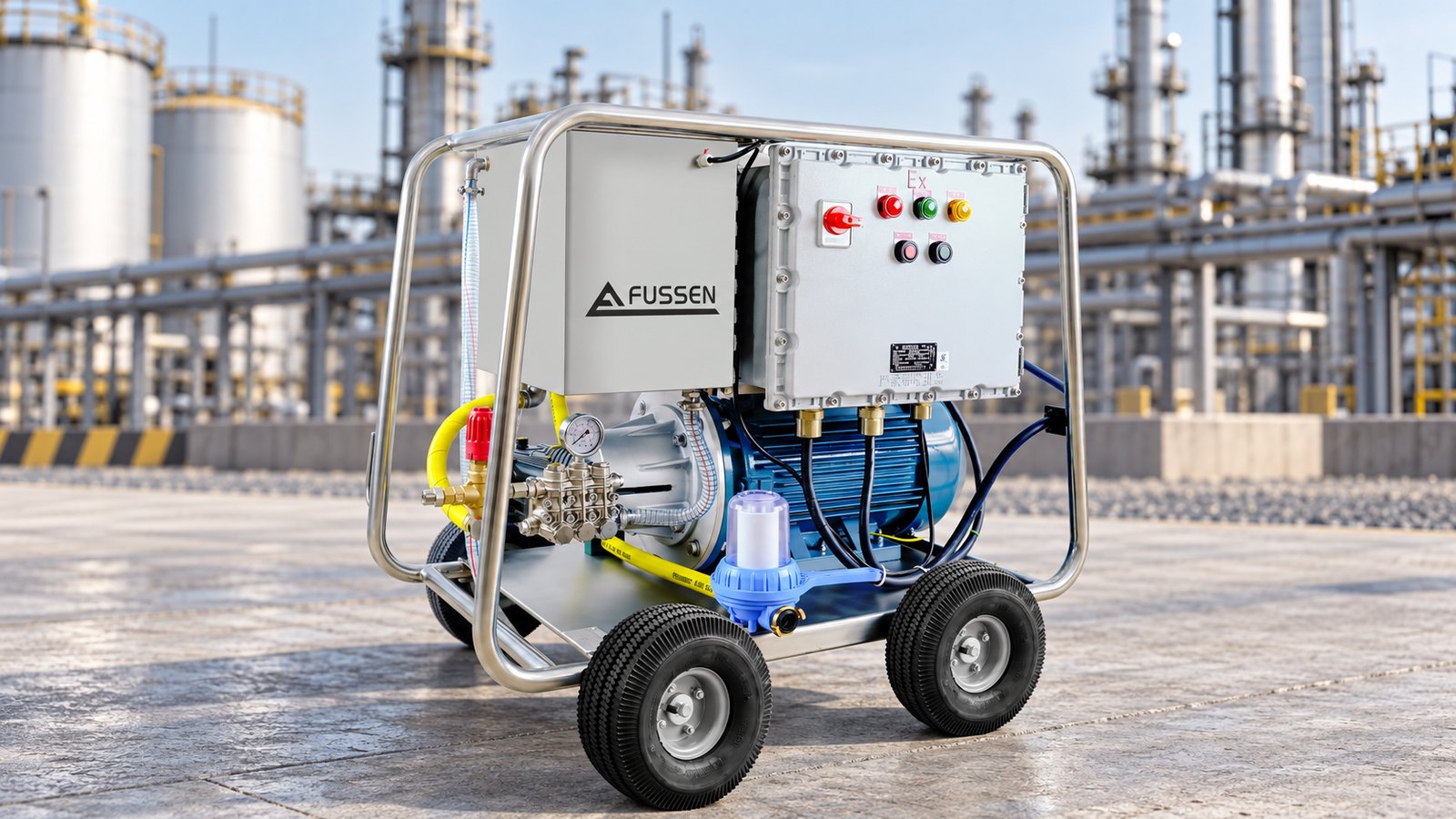
Plant maintenance teams routinely clean heat exchangers, loading bays and process floors in places where a single spark can ignite an explosive atmosphere. A standard electric washer carries four ignition sources: the motor, the contactor in the control box, static charge on the hose and lance, and hot surfaces. An explosion proof pressure washer is therefore not a normal machine with a different label; it is hazardous area cleaning equipment whose motor, controls, earthing and materials are designed and certified so they cannot become the ignition source. This guide explains zone classification, how to read an ATEX Ex marking element by element, what physically changes on the machine, which documents to demand, and how to specify a Fussen FAE-EX, FBE-EX, FCE-EX or FDE-EX unit for a given site.
What makes an atmosphere explosive
An explosion needs a flammable substance mixed with air in the right proportion, oxygen, and an ignition source with enough energy. Zoning deals with the first two; explosion-proof equipment deals with the third.
Flammable substances fall into two families that matter for cleaning equipment:
- Gases and vapours such as methane, propane, petrol vapour, hydrogen and solvent vapours. Each has explosive limits: petrol vapour between roughly 1.4% and 7.6% by volume in air, hydrogen between about 4% and 75%.
- Combustible dusts such as grain, flour, sugar, coal, aluminum and many plastics. A cloud is explosive above a few tens of grams per cubic meter, and a settled layer can smoulder on a hot surface long before a cloud forms.
Ignition energy varies enormously: hydrogen and acetylene ignite with about 0.02 mJ, less than a static discharge from a fingertip, while propane needs about 0.25 mJ. This is why gas groups exist. Hot surfaces are a separate hazard: every substance has an auto-ignition temperature, and a motor housing at 160°C will ignite carbon disulphide (about 90°C) with no spark at all. Temperature classes exist for this reason.
Zone classification: where the hazard exists and how often
Under the ATEX workplace directive (1999/92/EC) and IEC 60079-10, the site operator classifies areas into zones by how likely an explosive atmosphere is and how long it persists. The equipment directive (2014/34/EU) then defines which equipment categories may be used in each zone. The operator’s own hazardous area classification drawing is the document that governs.
| Zone (gas) | Zone (dust) | Presence of explosive atmosphere | Typical indication | Minimum equipment category | EPL |
|---|---|---|---|---|---|
| Zone 0 | Zone 20 | Continuously or for long periods | Inside a tank vapour space, inside a silo | Category 1G / 1D | Ga / Da |
| Zone 1 | Zone 21 | Likely in normal operation, occasionally | Around vents, filling points, pump seals, open mixing vessels | Category 2G / 2D | Gb / Db |
| Zone 2 | Zone 22 | Not likely in normal operation, and if it occurs, only briefly | Areas surrounding Zone 1, well-ventilated process halls | Category 3G / 3D | Gc / Dc |
A washer rated for Category 2 (Zone 1 or 21) may also be used in Zone 2 or 22, but never in Zone 0 or 20. Practically no pressure washer is certified for Zone 0; if a job requires cleaning inside a Zone 0 volume, the machine stays outside in a Zone 1 or 2 area and only the hose, lance and non-electrical tooling enter.
Mixed gas and dust sites
Refineries are gas sites, grain terminals are dust sites, and many facilities are both: a chemical plant with powder handling, or a paint shop with solvent vapour and pigment dust. A machine for such sites must carry both a G (gas) and a D (dust) marking, as the Fussen explosion-proof range does.
Reading an Ex marking element by element
The Ex marking is the most information-dense line on the rating plate. Fussen explosion-proof washers carry the following marking, decoded below:
II 2G Ex db mb ib px IIC T4 Gb, II 2D Ex tb pD IIIC T130°C Db
Equipment group: II
Group I is mining equipment used underground. Group II is everything else: surface industries, refineries, chemical plants, shipyards, food and grain facilities.
Category: 2G and 2D
Category 2 means a high level of protection, suitable for Zone 1 (G, gas) and Zone 21 (D, dust), and by extension Zone 2 and 22. The two comma-separated blocks are the gas and dust certifications. Category 1 would be needed for Zone 0/20; Category 3 is only sufficient for Zone 2/22.
Protection concepts: db, mb, ib, px, tb, pD
The letters after “Ex” say how each part of the machine is prevented from becoming an ignition source. A washer uses several concepts on different sub-assemblies, and the marking lists all of them. The suffix (a, b or c) is the protection level: “b” corresponds to EPL Gb/Db, Zone 1/21.
- db – flameproof enclosure. The enclosure can withstand an internal explosion and will not transmit it to the outside, because flame paths at joints are long and narrow enough to cool escaping gases below the ignition temperature. The Ex d motor and main control box are the classic examples; their joint surfaces must never be painted, damaged or fitted with non-original fasteners.
- mb – encapsulation. Components are potted in a resin compound so that no arc, spark or hot surface can reach the atmosphere. Used on sensors, solenoids and thermal protection devices.
- ib – intrinsic safety. The circuit is designed so that the energy available (voltage, current, stored energy) is too low to ignite the gas even under a defined fault condition. Used for pressure switches, sensors and the trigger circuit. “ib” allows one fault; “ia” would allow two.
- px – pressurised enclosure. An enclosure kept above ambient pressure with clean air or inert gas so that the explosive atmosphere cannot enter. “px” requires monitoring that removes power if purge pressure is lost.
- tb – protection by enclosure (dust). The dust equivalent of a flameproof approach: the enclosure is tight enough (typically IP6X) that combustible dust cannot enter, and surface temperature is limited so that a dust layer on the outside cannot ignite.
- pD – pressurisation for dust. The same purge concept as px, applied to dust atmospheres.
Gas group: IIC, and dust group: IIIC
Gas groups rank gases by ignition ease and by how readily flame passes through a gap. IIA covers propane and most hydrocarbons, IIB ethylene, IIC hydrogen and acetylene, the hardest to contain. IIC equipment is certified for everything below it. For dusts, IIIA is combustible flyings, IIIB non-conductive dust such as grain and flour, IIIC conductive dust such as aluminum or coal; IIIC covers all three. A IIC/IIIC machine has no group restriction on where it can be used, a real advantage for a contractor moving between sites.
Temperature class: T4 and T130°C
The temperature class is the maximum surface temperature the equipment can reach, which must be below the auto-ignition temperature of the gas present: T1 450°C, T2 300°C, T3 200°C, T4 135°C, T5 100°C, T6 85°C. T4 covers petrol, diesel, most solvents and hydrogen; a few substances such as carbon disulphide require T5 or T6. For dust the marking states the actual maximum surface temperature, here 130°C, which the site engineer compares with the ignition temperature of the dust cloud and of a settled layer, applying the margins in the standard.
Equipment protection level: Gb and Db
EPL is the IEC equivalent of the ATEX category: Gb means gas, high protection, Zone 1; Db means dust, high protection, Zone 21. Ga/Da would be Zone 0/20, Gc/Dc Zone 2/22.
What actually changes on the machine
An explosion-proof washer shares its pump and hydraulic circuit with the standard model, but every potential ignition source is redesigned. Knowing the differences helps a buyer judge whether a supplier’s claim is credible.
- Ex d motor. A flameproof unit with a cast housing, machined flame paths and a certified terminal box. It is derated so that surface temperature stays within T4 and carries a thermal sensor on the intrinsically safe control circuit. On a 15 kW-class machine the Ex motor can weigh 40 to 60 percent more than the standard one.
- Ex control box. Starter, overload and contactor live in a flameproof or pressurised box; operator controls are intrinsically safe or mechanical, and cables enter through certified glands only.
- Static earthing. A water jet at 300 bar generates charge, and a rubber hose insulates the lance from the chassis. The machine therefore has a dedicated earthing point for a bonding lead, a conductive high pressure hose, a conductive lance and gun, and non-insulating wheels. Continuity from nozzle to earth point should be verified at commissioning and after every hose change.
- Non-sparking mechanical parts. Fan blades, guards and parts that can strike each other are made from brass, bronze or suitable stainless grades, and aluminum is avoided where a thermite reaction with rusty steel is possible.
- Surface temperature management. Pump heads and unloader valves warm up in bypass, so bypass time before automatic shutdown is limited by a certified timer or by water temperature monitoring.
Documentation buyers should ask for
“ATEX” on a datasheet means nothing without paperwork; a Category 2 machine cannot be self-certified. Ask for the following before ordering:
- EU-type examination certificate issued by a notified body for the complete machine, not only for the motor. It names the manufacturer, product type, full Ex marking and any special conditions of use (an “X” after the certificate number). A machine assembled from certified components but never examined as an assembly is not a certified Category 2 machine.
- Notified body identification number, shown next to the CE mark and checkable in the EU NANDO database.
- EU declaration of conformity listing directive 2014/34/EU, the harmonised standards applied (EN IEC 60079 series, EN 1127-1) and the other applicable directives.
- Quality assurance notification for production confirming that series production matches the examined type.
- Operating and maintenance manual with the inspection schedule, the certified-spares list and the earthing procedure.
Fussen obtained EU-type examination for its explosion-proof washer range in 2025 and supplies the certificate and declaration with every unit.
The Fussen explosion-proof range: FAE-EX to FDE-EX
The four explosion-proof series mirror the standard electric line-up and share nozzles and pump spares with it. All four carry the II 2G/2D IIC/IIIC T4 marking.
| Series | Pressure range | Flow range | Models | Typical duties |
|---|---|---|---|---|
| FAE-EX explosion-proof washer | 150–250 bar | 15–18 L/min | FAE-EX 15/15, 15/20, 15/25, 18/20 | General plant washdown, vehicle and skid cleaning, bund and floor cleaning in Zone 1/2 |
| FBE-EX explosion-proof washer | 250–350 bar | 15–21 L/min | FBE-EX 15/30, 15/35, 18/28, 21/25 | Heat exchanger exteriors, structural steel, deck and tank exterior cleaning, paint shop grates |
| FCE-EX explosion-proof washer | 350–600 bar | 15–22 L/min | FCE-EX 21/35, 15/50, 22/50, 18/60 | Coating removal, scale and product build-up, tank internal cleaning with the machine outside the vessel |
| FDE-EX explosion-proof washer | 500–1000 bar | 15–36 L/min | FDE-EX 30/50, 20/80, 15/100, 36/50, 24/80, 18/100 | Tube bundle lancing, hydrodemolition of refractory, heavy coating and hard deposit removal |
Model numbers state flow first, then pressure: FBE-EX 21/25 delivers 21 L/min at 250 bar, FDE-EX 15/100 delivers 15 L/min at 1000 bar. Hydraulic power is roughly bar × L/min ÷ 600, so a FCE-EX 22/50 puts about 18 kW into the water and needs a motor around 22 kW after pump efficiency. The Ex motor for that duty is larger and heavier than the standard one, which affects footprint and lifting capacity on site.
Applications where an ATEX pressure washer is mandatory
Refineries and petrochemical plants
Turnaround cleaning of heat exchangers, pipe racks and bunds takes place in Zone 1 and 2 areas around process equipment, where an uncertified electric washer is not permitted. Gas group IIC matters because hydrogen units are common.
Tank farms and fuel terminals
Tank exteriors, bund floors and loading gantries are typically Zone 2 with Zone 1 pockets around vents. A FBE-EX at 250 to 350 bar handles fuel staining and coating preparation.
Offshore platforms and FPSOs
Nearly the whole process deck is classified. Contractors need a compact Ex washer with a certified earthing system and usually a stainless steel frame. The FCE-EX at 500 bar suits coating preparation on deck steel.
Paint shops, grain silos and other dust sites
Spray booths and solvent stores are Zone 1 during operation; a certified washer cleans booth grates and sludge conveyors without isolating the area. Grain silos, flour mills, sugar and feed plants are Zone 21 and 22 dust sites. The dust part of the marking, II 2D Ex tb pD IIIC T130°C Db, governs, and the 130°C surface limit must be compared with the layer ignition temperature of the product. Wet cleaning also raises far less airborne dust than sweeping or compressed air.
Specifying an explosion proof pressure washer: a checklist
Each point below corresponds to a reason machines have been refused site entry.
- State the zone from the site classification drawing (Zone 1, 2, 21 or 22) and confirm the machine is Category 2 (Gb/Db) if any Zone 1/21 use is possible.
- State the gas group; specify IIC if hydrogen or acetylene may be present or the machine will travel between sites.
- State the temperature class required (T4 covers most substances) and, for dust sites, the maximum permitted surface temperature.
- Require an EU-type examination certificate for the complete machine from a named notified body, plus the production quality assurance notification.
- Require an earthing point, a conductive hose and lance, and a continuity test record at delivery.
- Specify pressure and flow from the cleaning task; a FAE-EX 18/20 at 200 bar is adequate for washdown and far lighter to move than a FDE-EX.
- Specify supply voltage and materials, and confirm long-term availability of certified spares.
For a site-specific recommendation, send the zone classification, substances present and cleaning task to the Fussen engineering team through the contact page.
Need a recommendation?
Get a Quotation and Technical Recommendation Within 24 Hours
Send us your pressure, flow and application. Our engineers reply within 24 hours.

Fussen has designed and manufactured high pressure plunger pumps and industrial washers in Foshan, China since 2001. ISO 9001 / 14001 / 45001, CE and ATEX-certified, exporting to more than 60 countries.