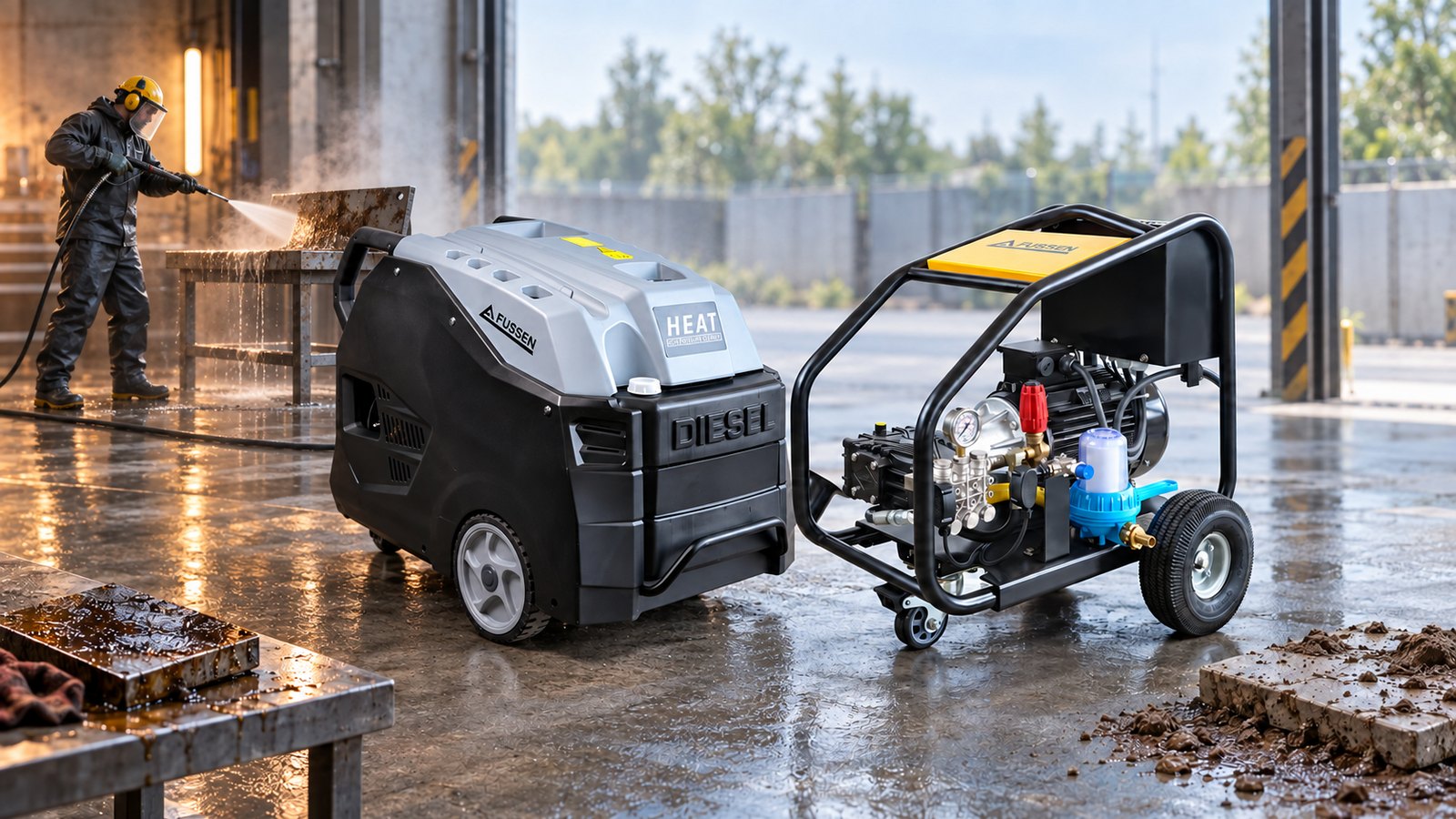
Every fleet workshop, food plant and engine room eventually meets a deposit that cold water will not shift: caked grease on a truck chassis, animal fat on a processing line, fuel oil on a tank top. The usual reaction is to buy more pressure. The better question is hot water pressure washer vs cold water: which one actually removes the soil faster, and does the extra cost of a burner or heating coil pay back? Hot water units cost more to buy, burn diesel or draw extra kilowatts, and need boiler maintenance. Cold water units are simpler, cheaper and adequate for a great deal of industrial cleaning. This guide sets out the physics that decides which wins, the temperature ranges you can expect, the applications where heat is decisive and where it is wasted, and a running-cost model with a worked return-on-investment table so you can put real numbers behind the decision.
The physics: why temperature changes what pressure can do
A pressure washer removes soil by three mechanisms: mechanical impact of the jet, dissolving or emulsifying the soil into the water, and carrying the loosened material away. Pressure improves the first. Temperature improves the second and third, and for oily soils that is where the work is.
Viscosity of grease and oil falls sharply with temperature
Mineral oils and animal fats are Newtonian or near-Newtonian fluids whose viscosity drops roughly exponentially with temperature. A typical heavy lubricating grease base oil at 20 °C might have a kinematic viscosity around 300 mm²/s; at 60 °C it is closer to 40 mm²/s and at 90 °C around 15 mm²/s. Animal fats and many waxes are solid or semi-solid below 35-45 °C and become mobile liquids above it. Once the soil is a low-viscosity liquid, the jet can push it and the water can carry it. Cold water at 500 bar can cut a groove through a grease layer, but the grease on either side of the groove stays put because it is still a solid.
Emulsification and detergent activity
Detergents work by surrounding oil droplets with surfactant molecules so they disperse in water. Surfactant activity rises with temperature, and most industrial degreasers are formulated to work best between 50 and 80 °C. Above the cloud point of a non-ionic surfactant (often 50-70 °C), its oil-removing power peaks. Heated water also increases the rate of every chemical reaction involved, roughly doubling for each 10 °C rise, so an alkaline cleaner that needs 10 minutes of contact time at 20 °C may need 2 to 3 minutes at 60 °C.
Thermal shock and expansion
Hot water expands the soil layer and the substrate at different rates, which helps to lift brittle deposits such as chewing gum, tar and some paints. Chewing gum, for example, softens above about 50 °C and can be removed at low pressure with hot water and a little steam, where cold water simply polishes it.
Temperature ranges: what a hot water pressure washer actually delivers
Hot water units heat the water after the pump, not before. The pump handles cold inlet water (which protects seals and prevents cavitation), then the discharge passes through a heating coil before the hose. There are two heating methods in industrial machines.
| Heating method | Outlet temperature | Typical heat input | Fussen series | Notes |
|---|---|---|---|---|
| Diesel burner and coil | Adjustable, up to 90 °C | 60-100 kW thermal | FHP, FHS | Independent of mains capacity; needs fuel and flue |
| Electric heating element | Adjustable, typically up to 80-90 °C at reduced flow | 18-36 kW electrical | FHE | No combustion; needs a large electrical supply |
| Cold water (reference) | Inlet temperature, 5-25 °C | None | FAE, FBE, FCE | Lowest capital and running cost |
The heat needed is simple to calculate. Raising 15 L/min of water by 60 °C (from 20 to 80 °C) requires 15 × 60 × 4.19 / 60 = 62.9 kW of heat delivered to the water. A diesel burner at 85-90 % combustion efficiency therefore burns about 70-74 kW of fuel, and an electric coil needs a 63 kW supply for the same result, which is why electric hot water units are usually limited to lower flow, lower temperature rise, or both. Fussen’s FHP and FHS diesel-heated units cover 200-250 bar at 15-18 L/min with the outlet adjustable up to 90 °C; the FHE electric-heated series offers the same pressure and flow envelope where combustion is not permitted.
Where hot water wins
The applications below share one feature: the soil is oily, fatty or thermoplastic, so heat cuts the time per item substantially.
Fleet and plant machinery
Truck chassis, tippers, construction plant and agricultural machinery carry a mixture of road grime, grease and hydraulic oil. Cold water leaves a film that reappears as a smear when it dries. At 70-80 °C the film emulsifies with a light detergent dose and rinses clean. A wash that takes 40 minutes cold typically takes 20-25 minutes hot, and the machine can be inspected immediately.
Food and agricultural processing
Animal fats, vegetable oils, milk residues and sugar syrups are solid or sticky at ambient temperature. Hygiene regimes in meat, dairy and bakery plants rely on hot water at 55-70 °C to melt the fat and activate alkaline foam cleaners before rinsing. Livestock and poultry houses use hot water to break down manure and biofilm between flocks.
Engine rooms, workshops and oil handling areas
Fuel oil, lubricating oil and grease on bilge plating, tank tops, separator rooms and workshop floors are the classic hot water job. Here a 200-250 bar unit at 80-90 °C outperforms a 500 bar cold unit, because the problem is viscosity rather than adhesion.
Chewing gum, graffiti and tar
Municipal and facility contractors remove chewing gum with hot water and steam at low pressure, which softens the gum without blasting the paving. Some graffiti and adhesives respond to heat with a suitable remover, and bitumen softens above 60 °C.
Where cold water is enough
Buying heat you do not use is expensive, so recognize when cold water is the correct choice.
- Mud, sand, dust and loose dirt on vehicles, plant and paving: purely mechanical soil that rinses off at 150-250 bar with a fan nozzle.
- Concrete, stone and masonry cleaning: moss, algae and weathering respond to pressure and flow, not temperature.
- Hull fouling, marine growth and scale: barnacles need 350-600 bar and a rotating nozzle; heat adds nothing.
- Paint and coating removal, surface preparation: ultra-high-pressure work at 700-2,800 bar is always cold water; the energy is in the jet.
- Sewer and drain jetting, hydro-demolition, tube cleaning: high flow and high pressure cold water.
- Rinsing after a hot detergent wash: a second cold water unit is often cheaper than running the burner for the rinse.
For these tasks, a cold water electric washer such as the FAE 150-250 bar series for general cleaning or the FCE 350-600 bar series for heavy deposits gives the same result at a lower purchase price and no fuel cost.
Running cost model: diesel, electricity and labour
A fair comparison includes three costs: energy for heating, the extra purchase price amortised over the life of the machine, and the labour time saved. The last one usually dominates.
Diesel burner consumption rule of thumb
Diesel has a heating value of about 10 kWh per liter (36 MJ/L). With burner efficiency around 85 %, each liter delivers about 8.5 kWh to the water. To heat 15 L/min by 60 °C you need 62.9 kW, so the burner consumes 62.9 / 8.5 = 7.4 liters per hour at full temperature and full flow. A simpler rule: a burner uses about 0.5 L of diesel per hour for every L/min of pump flow at a 60 °C rise, or roughly 7-9 L/h on a 15-18 L/min machine at full heat. Running at 60 °C instead of 80 °C cuts consumption by about a third, and the burner cycles off whenever the trigger is released.
Electric heating consumption
Electric heating has no combustion loss, so the water receives almost all of the input: 63 kW for the same 60 °C rise at 15 L/min. Most sites cannot provide that in addition to the pump motor, so electric hot water units typically run at a 30-50 °C rise or lower flow. Electricity usually costs two to three times as much per kWh of heat as diesel, but avoids fuel handling, flue gases and burner maintenance.
Labour and water
Field experience across fleet and industrial cleaning is that hot water reduces cleaning time on oily soils by 30-50 % and detergent consumption by a similar proportion. Water use falls in proportion to time, and labour is typically the largest single line in the cost of a wash.
Worked ROI table: hot water pressure washer vs cold water in a fleet workshop
Assumptions: a workshop cleans 8 vehicles per day, 250 days per year; a cold wash averages 40 minutes, a hot wash 25 minutes; the operator’s fully loaded cost is 30 per hour; diesel costs 1.20 per liter; electricity 0.20 per kWh; the hot water unit consumes 6 L/h of diesel while heating and heats for 70 % of wash time; the hot water unit costs 4,000 more than the equivalent cold unit and both use a 7.5 kW pump motor. Currency units are deliberately generic; substitute your own rates.
| Item (per year) | Cold water unit | Hot water unit (diesel burner) |
|---|---|---|
| Wash time per vehicle | 40 min | 25 min |
| Machine hours per year (2,000 vehicles) | 1,333 h | 833 h |
| Labour cost at 30/h | 40,000 | 25,000 |
| Pump electricity (7.5 kW × hours × 0.20) | 2,000 | 1,250 |
| Diesel for burner (6 L/h × 70 % × hours × 1.20) | 0 | 4,200 |
| Detergent (30 % less with hot water) | 1,500 | 1,050 |
| Burner and coil maintenance (filters, nozzles, descaling) | 0 | 600 |
| Total annual operating cost | 43,500 | 32,100 |
| Annual saving with hot water | 11,400 | |
| Extra purchase price of hot water unit | 4,000 | |
| Simple payback | About 4 months | |
The result is not sensitive to the exact fuel price: even at double the diesel cost the payback is about seven months, because the saving comes from labour. Where the model flips is utilisation and soil type. If the same workshop cleans two vehicles a day, the annual labour saving falls to about 3,750 and payback stretches past a year; if the soil is mud rather than grease, the hot wash is not faster and the burner is pure cost. The decision rule: if the soil is oily and the machine will run more than about 300 hours per year, hot water pays back within the first year.
Maintenance of boilers and heating coils
A hot water unit adds a fuel system and a heat exchanger to the pump, and both need routine attention.
Descaling the coil
Hard water deposits calcium carbonate on the inside of the heating coil, and the rate rises steeply with temperature. A 1 mm scale layer reduces heat transfer by roughly 10 % and raises the coil wall temperature, which shortens its life. Symptoms are a falling outlet temperature at the same burner setting and rising pressure drop through the coil. Descale with an inhibited acid solution circulated at low pressure every 200-400 hours in hard-water areas (above about 15 °dH), or fit a water softener or inline scale inhibitor and extend the interval to 1,000 hours or more.
Fuel system
- Replace the burner fuel filter every 200-300 hours or when the flame becomes yellow or smoky.
- Use clean, water-free diesel; water in the fuel corrodes the burner nozzle and causes ignition faults.
- Inspect the burner nozzle and electrodes every 500 hours; replace the nozzle annually. A worn nozzle over-fuels and soots the coil.
- Check the fuel pump pressure and the air damper setting against the manual; a sooted coil is nearly always a combustion adjustment problem.
Electric coil units
Electric heating elements have no burner but are still subject to scale on the element surface, which raises element temperature and shortens life. Descale on the same schedule and check the element insulation resistance annually. Confirm that the flow switch that prevents dry-firing operates correctly at every service.
Pump side
The pump on a hot water unit sees cold inlet water and is maintained like any other triplex plunger pump: oil change at 50 hours then every 500 hours, seals inspected at 500 hours. Because the heated water passes through the unloader and hose, specify FKM or PTFE seals downstream of the coil, and a hose rated for the outlet temperature.
Choosing between Fussen FHP, FHS and FHE hot water series
Fussen builds three hot water high pressure washer series, all with triplex ceramic plunger pumps, covering 200-250 bar and 15-18 L/min.
| Series | Heating | Models | Pressure | Flow | Typical use |
|---|---|---|---|---|---|
| FHP | Diesel burner, up to 90 °C | FHP 15/20, FHP 18/20, FHP 15/25 | 200-250 bar | 15-18 L/min | Fleet workshops, plant hire, general industrial degreasing |
| FHS | Diesel burner, up to 90 °C | FHS 15/20, FHS 18/20, FHS 15/25 | 200-250 bar | 15-18 L/min | Stationary installations, food and agricultural plants, engine rooms |
| FHE | Electric heating | FHE 15/20, FHE 18/20, FHE 15/25 | 200-250 bar | 15-18 L/min | Indoor sites where combustion is not permitted |
Model numbers follow the pattern flow/pressure: FHP 15/25 delivers 15 L/min at 250 bar; FHP 18/20 delivers 18 L/min at 200 bar. For grease removal, flow at moderate pressure carries more heat to the surface than pressure alone, so the 18/20 model is often the better choice for vehicle and plant cleaning, while the 15/25 suits tasks that combine oil with harder deposits. All three series can be fitted with a stainless steel pump head for detergent-heavy or hygiene applications; the FAS stainless steel plunger pump is the corresponding bare pump for OEM integrators.
Decision checklist
- Identify the soil. Oil, grease, fat, wax, gum or tar: hot water. Mud, sand, scale, marine growth, coatings: cold water.
- Estimate annual hours. Above 300 hours on oily soils, a hot water unit pays back within a year in most cost structures.
- Check the site. Is a diesel burner acceptable (ventilation, flue, fuel storage)? If not, an electric-heated unit and a supply of 20-40 kW beyond the pump motor.
- Check water hardness and plan descaling or softening.
- Match flow and pressure: 18 L/min at 200 bar for vehicles and plant; 15 L/min at 250 bar for mixed deposits.
- Specify temperature-rated seals, hose and gun; confirm the trigger-off burner interlock and over-temperature cut-out.
- Consider two machines: one hot water for degreasing and one cold water for rinsing and general work, so the burner runs only when it earns its keep.
If you are unsure whether heat will pay back on your application, contact the Fussen team with the soil type, hours per year, water hardness and power supply, and we will recommend between the FHP, FHS and FHE hot water series and an equivalent cold water unit with the numbers to support it.
Frequently asked questions
Is a hot water pressure washer better than a cold water one?
Only for the right soil. On oil, grease, fat, wax, chewing gum and tar, hot water at 60-90 °C cleans 30-50 % faster and with less detergent because it lowers the soil's viscosity and activates surfactants. On mud, sand, masonry, marine fouling and coating removal, cold water at the correct pressure gives the same result at lower cost.
How much diesel does a hot water pressure washer burner use?
Roughly 7-9 liters per hour for a 15-18 L/min machine at full temperature. The figure follows from physics: heating 15 L/min by 60 °C needs about 63 kW, and a liter of diesel delivers about 8.5 kWh through an 85 % efficient burner. Lower outlet temperatures and trigger-off burner cut-out reduce actual consumption.
What temperature does a Fussen hot water pressure washer reach?
The diesel-heated FHP and FHS series deliver adjustable outlet temperatures up to 90 °C at 200-250 bar and 15-18 L/min. The FHE series uses electric heating for sites where combustion is not permitted, with temperature rise limited by the available electrical supply.
How often should the heating coil be descaled?
In hard water (above about 15 °dH), every 200-400 running hours; with a softener or inline scale inhibitor, every 1,000 hours or more. A falling outlet temperature at the same burner setting or a rising pressure drop across the coil are the signs that scale has built up.
Can I use hot water for hull cleaning or paint removal?
There is no benefit. Marine fouling and coatings are removed by jet impact energy, which depends on pressure and flow. These are cold water tasks at 350-600 bar for fouling and 700-2,800 bar for coating removal, and heating the water only adds fuel cost.
Need a recommendation?
Get a Quotation and Technical Recommendation Within 24 Hours
Send us your pressure, flow and application. Our engineers reply within 24 hours.

Fussen has designed and manufactured high pressure plunger pumps and industrial washers in Foshan, China since 2001. ISO 9001 / 14001 / 45001, CE and ATEX-certified, exporting to more than 60 countries.