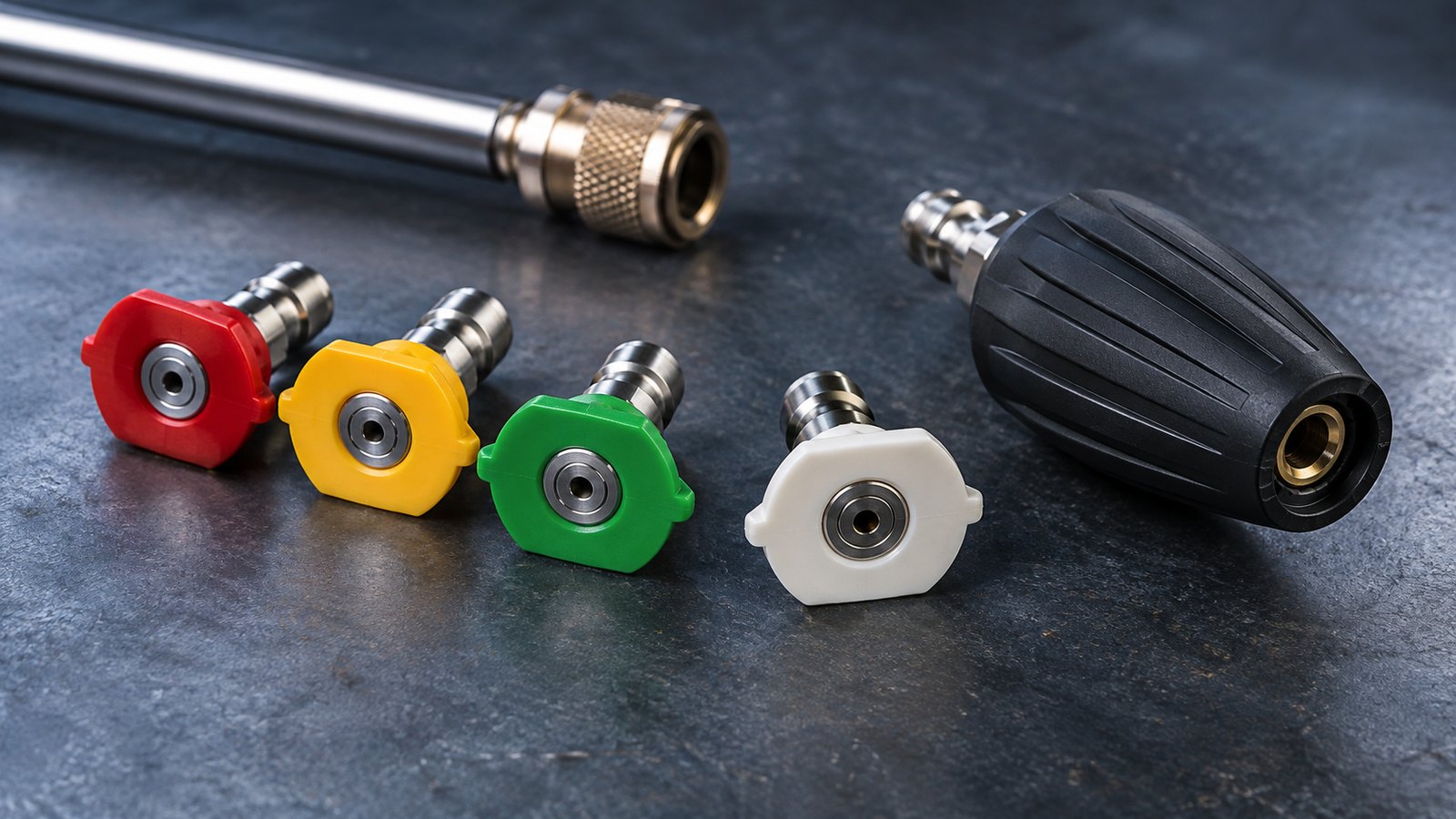
Most calls about a “weak” or “overloaded” pressure washer end the same way: the pump is fine, the motor is fine, and the wrong nozzle is fitted. A pressure washer nozzle chart is the tool that prevents that. It tells you, for any orifice size, how much water passes through at a given pressure, which is the only way to match a nozzle to a pump correctly. The pump sets the flow; the nozzle sets the pressure. Too small an orifice and the unloader bypasses flow and heats the water; too large and rated pressure is never reached. This guide explains how to read a nozzle chart, how the nozzle number conventions work, how to run the arithmetic yourself with a simple nozzle size calculator formula, and how spray angle, wear and safety fit into the decision.
Why the nozzle orifice sets the pressure, not the pump
A triplex plunger pump is a positive-displacement machine. For a given crankshaft speed it delivers an almost constant volume per revolution, whether the outlet is open or restricted. It does not “make” pressure by itself. Pressure appears because the flow is forced through a restriction: the spray nozzle orifice. The smaller the hole, the higher the pressure needed to push the pump’s fixed flow through it.
The relationship follows from Bernoulli’s equation. For a sharp-edged orifice, flow Q is proportional to the orifice area multiplied by the square root of the pressure drop:
Q = C × A × √(2ΔP/ρ), which for practical work reduces to Q ∝ d² × √P
Two consequences of this equation matter on the shop floor:
- At a fixed nozzle, flow scales with the square root of pressure. Doubling pressure raises flow through the same orifice by only about 41 percent (√2 = 1.41).
- At a fixed flow, pressure scales with the square of the flow-to-nozzle ratio. Pushing 10 percent more flow through the same orifice raises pressure by about 21 percent (1.1² = 1.21). A small change in orifice diameter therefore produces a large change in operating pressure.
This is why a nozzle chart exists: it tabulates the flow through each standard orifice at each pressure so you can find the nozzle that passes your pump’s flow at the pressure you want. A rating plate reading 15 L/min at 200 bar only describes what the pump delivers with a correctly sized nozzle. Fit any other nozzle and the machine runs at a different pressure.
How to read a pressure washer nozzle chart
A full chart typically lists 30 or more nozzle sizes across pressures from 20 to 200 bar. The condensed table below is extracted from the chart Fussen supplies with its washers and pumps, showing eight commonly used sizes at the three pressures most relevant to electric and engine-driven washers in the 100 to 200 bar class.
| Nozzle number | Orifice Ø (mm) | Flow at 100 bar (L/min) | Flow at 150 bar (L/min) | Flow at 200 bar (L/min) |
|---|---|---|---|---|
| 03 | 1.09 | 6.8 | 8.3 | 9.6 |
| 04 | 1.19 | 9.1 | 11.1 | 12.9 |
| 045 | 1.27 | 10.3 | 12.6 | 14.6 |
| 05 | 1.35 | 11.4 | 14.0 | 16.1 |
| 06 | 1.47 | 13.7 | 16.8 | 19.4 |
| 07 | 1.60 | 16.0 | 19.6 | 22.6 |
| 08 | 1.70 | 18.2 | 22.3 | 25.7 |
| 10 | 1.90 | 23.0 | 28.2 | 32.5 |
To use it, work in three steps:
- Find your pump’s flow. Use the nameplate value or, better, measure it (fill a calibrated container for 30 seconds with the nozzle removed and double the result).
- Find the pressure you want to run. This is the column. It must not exceed the pump, hose, gun or unloader rating.
- Read the nozzle whose flow at that pressure is closest to, but not below, your pump flow. A slightly higher chart value means the machine runs a little under target; a lower value means it runs over target and the unloader begins to bypass.
Check the square-root rule against the table: nozzle 05 passes 11.4 L/min at 100 bar and 16.1 L/min at 200 bar, a ratio of 1.41, exactly √2.
Extending the chart above 200 bar
Many industrial washers run at 250, 350 or 500 bar, beyond the range of a standard chart. You do not need a second chart. Use the value at 200 bar and scale it:
QP = Q200 × √(P / 200)
For 350 bar the multiplier is √1.75 = 1.32; for 500 bar it is √2.5 = 1.58. Nozzle 04, which passes 12.9 L/min at 200 bar, therefore passes about 17.1 L/min at 350 bar and 20.4 L/min at 500 bar. Above roughly 300 bar, confirm the actual orifice diameter rather than relying on the stamped number, since insert materials and numbering vary.
Nozzle number conventions explained
The nozzle number is not the orifice diameter in millimetres, which causes endless confusion. The two-digit number used on most industrial washer nozzles follows the North American convention: it is approximately the flow in US gallons per minute that the nozzle passes at 4,000 psi (about 276 bar). A “05” nozzle passes about 5 US gpm at 4,000 psi. Check it against the chart: 16.1 L/min at 200 bar scaled to 276 bar gives 16.1 × √1.38 = 18.9 L/min, which is 5.0 US gpm. The convention holds.
Because the number scales with flow, and flow scales with diameter squared, the orifice grows slowly as the number rises: a 04 to an 08 doubles the flow but only takes the orifice from 1.19 mm to 1.70 mm. Three points follow:
- Half sizes (035, 045, 055, 065) exist because a full step is a large change in operating pressure. Between 04 and 05 at a fixed 15 L/min the pressure difference is roughly 100 bar.
- Nozzles are often marked with the spray angle and size combined: “2505” is a 25 degree fan, size 05. “1503” is a 15 degree fan, size 03. The first two digits are the angle, the last two or three the size.
- European suppliers sometimes mark nozzles by orifice diameter in tenths of a millimetre or by flow at a reference pressure such as 100 bar. Always convert to orifice diameter or to the chart before comparing brands.
Spray angles: 0°, 15°, 25°, 40° and rotating nozzles
Spray angle does not change flow or pressure; two nozzles of the same size but different angles pass the same water at the same pressure. What changes is impact per unit area on the surface.
0° pencil jet (red)
Maximum impact, minimum coverage. Used for cutting caked material and reaching into recesses. It will gouge wood and concrete and strip paint unintentionally, and it can injure; never point it at people.
15° (yellow)
The general-purpose stripping angle. It removes paint, rust scale and heavy grease in a stripe typically 5 to 8 cm wide at 20 cm stand-off, and is the usual choice for industrial cleaning of robust surfaces.
25° (green)
The default angle for vehicles, machinery, walls and floors, and the nozzle most washers are shipped with.
40° (white)
Low impact, wide coverage: rinsing, painted or glazed surfaces and detergent application.
Rotating (turbo) nozzles
A rotating nozzle spins a 0 degree jet in a cone of 15 to 25 degrees at several thousand revolutions per minute, giving pencil-jet impact with fan coverage. Cleaning rate is often two to three times that of a fixed 15 degree fan at the same flow and pressure. The trade-offs are cost, sensitivity to dirt (a stalled rotor delivers a stationary 0 degree jet) and shorter life. Turbo nozzles carry the same size numbers and are chosen from the chart in the same way.
Worked examples: which orifice for your pump
The arithmetic is short. Use these two formulas, where Q is flow in L/min and P is pressure in bar:
- Pressure at a given nozzle: Pactual = Pchart × (Qpump / Qchart)²
- Flow at a given pressure: QP = Qchart × √(P / Pchart)
Example 1: pump gives 15 L/min, target 200 bar
This is a typical FAE series electric washer such as the FAE 15/20, or a bare FAB series plunger pump in the 15 L/min, 200 bar class. On the chart at 200 bar, nozzle 045 passes 14.6 L/min and nozzle 05 passes 16.1 L/min. Neither is exact, so calculate both:
- Nozzle 045: P = 200 × (15 / 14.6)² = 211 bar. Slightly above target; acceptable only if the pump, hose and unloader are rated for 220 bar or more.
- Nozzle 05: P = 200 × (15 / 16.1)² = 174 bar. Slightly below target; the machine is fully protected but gives up 13 percent of the rated pressure.
For a machine rated at 200 bar maximum, fit the 05 and accept 174 bar, or fit the 045 with the unloader set to 200 bar. For a 250 bar pump, fit the 045.
Example 2: 15 L/min at 300 bar
A FBE series washer such as the FBE 15/30 delivers 15 L/min at 300 bar. The chart stops at 200 bar, so scale it. Nozzle 04 passes 12.9 L/min at 200 bar, or 12.9 × √1.5 = 15.8 L/min at 300 bar. Nozzle 035 passes 11.3 × 1.22 = 13.8 L/min at 300 bar. With 15 L/min the 04 gives 200 × (15 / 12.9)² = 270 bar and the 035 gives 200 × (15 / 11.3)² = 352 bar. The 04 is the safe choice; a 0375 intermediate size, where available, would land close to 300 bar.
Example 3: 50 L/min at 200 bar
High-flow machines such as the FLE 50/20 need larger orifices. At 200 bar the full chart shows nozzle 15 (2.34 mm) at 48.1 L/min and nozzle 16 (2.41 mm) at 50.9 L/min. The 16 gives 193 bar and is the correct fit; a 15 would push the machine to 216 bar.
What goes wrong with the wrong nozzle
Nozzle too small: bypass, heat and seal damage
When the orifice cannot pass the pump’s flow at the unloader’s set pressure, the unloader diverts the surplus back to the inlet. Every bypassed liter has been pressurised and then throttled, and that energy appears as heat in the water. A 5.5 kW machine bypassing half its flow puts roughly 2 kW of heat into a few liters of recirculating water; once it passes about 60 °C the plunger seals and valve seats begin to fail. Symptoms are a hot pump head, water from the weep holes, a chattering unloader and loss of pressure after minutes of running. The classic cause is a nozzle blocked by scale or debris, which is why an inlet filter is cheap insurance.
Nozzle too large: no pressure, no cleaning
An oversized orifice passes the pump’s flow at a lower pressure, and the unloader cannot help. A 06 nozzle on a 15 L/min pump gives only 200 × (15 / 19.4)² = 120 bar. The unloader can limit pressure, not create it. Worn nozzles produce the same symptom gradually.
Nozzle wear, inspection and replacement intervals
Fine particles in the water erode the orifice edge and the orifice grows. Because pressure depends on the square of the flow-to-orifice ratio, a small growth in diameter causes a large loss of pressure:
| Orifice growth | Area increase | Pressure at fixed pump flow |
|---|---|---|
| 0 % (new, 1.35 mm) | 0 % | 200 bar |
| +5 % (1.42 mm) | +10 % | 165 bar |
| +10 % (1.49 mm) | +21 % | 137 bar |
| +15 % (1.55 mm) | +32 % | 115 bar |
A nozzle that has grown by 10 percent, invisible to the eye, has cost you a third of the machine’s pressure. Rules of thumb for managing this:
- Replace when pressure at the gauge has fallen 10 to 15 percent with the same pump and the unloader fully open. This is the only reliable criterion. Compare against the reading recorded when the nozzle was new.
- Typical service life is a few hundred hours for hardened stainless nozzles in clean water, and much less with recycled or sandy water. Ceramic or carbide inserts last several times longer and are worth the cost on machines that run daily.
- Never clean a nozzle with a wire or drill; use the plastic pin supplied or back-flush. A scratched orifice sprays a ragged pattern and wears faster.
- Keep a log per machine: nozzle size, date fitted, gauge pressure when new. A streaky fan pattern means the nozzle is damaged even if the pressure still reads correctly.
Safety when changing and using nozzles
A jet at 200 bar will penetrate skin at close range; at 500 bar it will penetrate boots and heavy clothing. Nozzle selection is part of safe operation.
- Check hose and gun ratings against the pressure calculated from the chart, not the nameplate. An undersized nozzle can push hose pressure above its rating. Working pressure should at least equal the unloader setting, with burst pressure typically three to four times higher.
- Release trigger pressure and stop the pump before removing a nozzle. Quick-connect nozzles can be ejected if changed under pressure.
- Reaction force on the gun rises with pressure and flow and can exceed 100 N on a 20 L/min, 300 bar machine; keep firm footing and never use a 0 degree or rotating nozzle near the body.
- Wear eye protection, gloves and waterproof boots as a minimum; above 300 bar use jetting-rated body protection.
Choosing nozzles for Fussen washers and pumps
Every Fussen washer ships with a nozzle sized to its pump. When you buy a bare FBB series pump for an OEM build, the nozzle is your responsibility and the chart is the starting point. For the 350 to 600 bar class such as the FCE series washers, use the scaling formula above and confirm the orifice with the nozzle supplier. For a recommendation on a specific pump, flow and target pressure, send the figures through our contact page and our engineers will size it for you.
Frequently asked questions
How do I calculate nozzle size without a chart?
Use a known point: if a nozzle passes Q1 at P1, at P2 it passes Q1 x sqrt(P2/P1). To size a nozzle for a pump, take the flow at your target pressure from one chart row and scale the orifice area in proportion to the flow ratio, then convert area back to diameter.
Can I use a smaller nozzle to get more pressure from my washer?
Only up to the unloader setting and the pressure rating of the pump, hose and gun. Beyond that the unloader bypasses the surplus flow and the machine overheats. The pump's rated pressure is a ceiling.
Does the spray angle change the flow?
No. Flow and pressure depend only on the orifice size. The angle changes how the jet energy is spread on the surface, not how much water passes.
What does the number 2505 on a nozzle mean?
25 degree spray angle, size 05 orifice (about 1.35 mm), which passes roughly 16 L/min at 200 bar.
How often should I replace a pressure washer nozzle?
When gauge pressure has dropped 10 to 15 percent from the reading with a new nozzle, or when the spray pattern becomes streaky. In daily industrial use with clean water that is typically a few hundred hours; with dirty water it can be far less.
Need a recommendation?
Get a Quotation and Technical Recommendation Within 24 Hours
Send us your pressure, flow and application. Our engineers reply within 24 hours.

Fussen has designed and manufactured high pressure plunger pumps and industrial washers in Foshan, China since 2001. ISO 9001 / 14001 / 45001, CE and ATEX-certified, exporting to more than 60 countries.