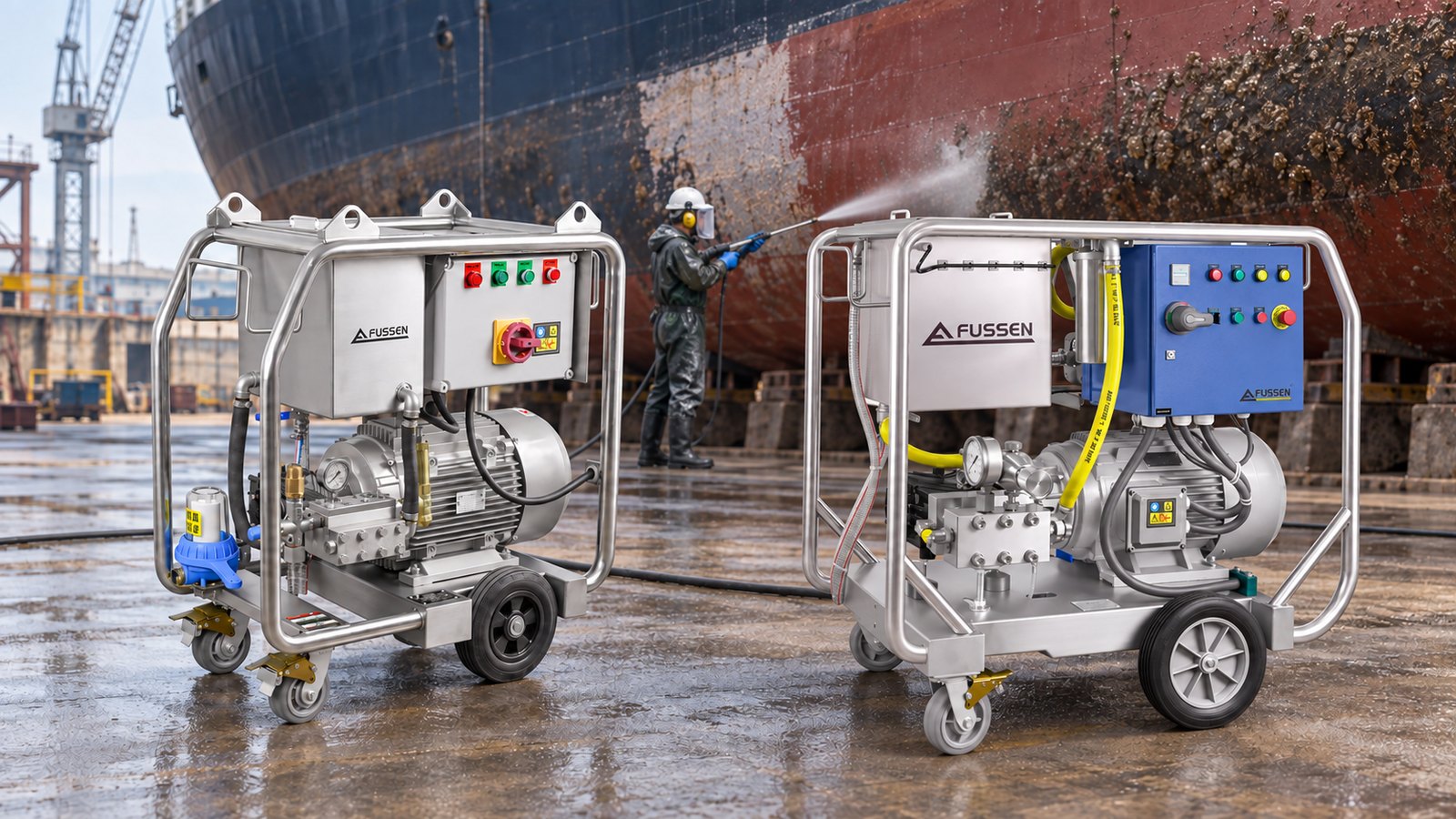
A vessel in dry dock costs money every hour it sits on the blocks, and the first job on almost every docking list is cleaning: knocking barnacles and slime off the hull, stripping failed antifouling, degreasing the engine room and washing tanks before survey. Choosing the wrong ship hull cleaning pressure washer shows up immediately as slow progress, blocked nozzles, corroded pumps and crews standing idle while a machine is repaired. This buyer’s guide is written for shipyard managers, ship chandlers and fleet superintendents who need to specify shipyard cleaning equipment that survives salt water, runs on ship’s power or yard diesel, and can be supported with spare parts in any port. It covers the main cleaning tasks, the pressure and flow each one actually needs, the materials that resist seawater, power options, what to expect from an IMPA supplier, and a practical checklist you can use before issuing a purchase order.
Cleaning tasks on ships and in shipyards
A single marine pressure washer rarely does every job well, because the tasks span a very wide range of pressure and flow. It helps to separate them clearly before looking at machines.
Hull fouling removal in dry dock
Soft fouling (slime, algae, weed) comes off easily; hard fouling (barnacles, tube worms, mussels) is bonded to the coating and needs a combination of pressure and impact energy. Yards clear soft growth with a fan nozzle, then use a rotating nozzle on calcareous fouling, aiming to remove the organisms without gouging sound antifouling.
Salt, rust and loose scale
Fresh-water washing before any coating work removes chloride contamination. Salt on a surface that is then painted causes osmotic blistering, so many coating specifications require a wash-down and a soluble-salt test before the primer goes on. This is a flow-driven job: volume of water matters more than pressure.
Antifouling and coating removal
Removing an entire antifouling scheme or blasting back to bare steel is ultra-high-pressure (UHP) water-jetting work. It replaces grit blasting without dust and needs 1,000 to 2,800 bar from a machine class designed for that duty.
Deck, superstructure and tank cleaning
Weather decks, hatch covers, accommodation exteriors and cargo holds are cleaned at moderate pressure with high flow so that large areas are covered quickly. Ballast and cargo tank washing is often done with fixed or portable tank-cleaning nozzles fed by a pump at 100 to 250 bar.
Engine room degreasing with hot water
Bilges, tank tops, engine casings and separator rooms carry fuel oil and lubricating grease. Cold water at any pressure only moves the grease around; hot water at 60 to 90 °C reduces its viscosity, lets detergent emulsify it and takes it away. A hot water pressure washer is the correct tool here, not a higher-pressure cold one.
Ship hull cleaning pressure washer: pressure and flow per task
Pressure determines whether a deposit breaks; flow determines how fast you cover the area and carry debris away. The figures below are engineering starting points used across shipyards and are consistent with the operating ranges of the Fussen machines listed later.
| Task | Typical pressure | Typical flow | Water temperature | Nozzle type |
|---|---|---|---|---|
| Soft fouling (slime, weed) | 150-250 bar | 15-40 L/min | Cold | 25° fan |
| Hard fouling (barnacles) | 350-600 bar | 15-30 L/min | Cold | Rotating / turbo |
| Salt and chloride wash-down | 100-200 bar | 40-70 L/min | Cold fresh water | 40° fan |
| Antifouling removal (selective) | 700-1,000 bar | 15-36 L/min | Cold | Rotating UHP |
| Full coating removal to bare steel | 1,500-2,800 bar | 15-40 L/min | Cold | UHP rotary head |
| Deck and hatch cover cleaning | 150-250 bar | 15-21 L/min | Cold or 40-60 °C | 15°-25° fan |
| Tank washing (portable nozzles) | 100-250 bar | 20-60 L/min | Cold or warm | Rotating tank nozzle |
| Engine room and bilge degreasing | 200-250 bar | 15-18 L/min | 70-90 °C | 15°-25° fan, low-pressure detergent |
Two rules of thumb are worth remembering. First, hydraulic power at the nozzle is roughly pressure (bar) multiplied by flow (L/min) divided by 600, giving kW: a 500 bar, 22 L/min machine delivers about 18 kW of water power and needs a 22 to 25 kW motor. Second, reaction force at the lance in newtons is roughly 0.24 times flow (L/min) times the square root of pressure (bar): at 500 bar and 22 L/min that is about 116 N, comfortable for a trained operator; at 1,500 bar and 20 L/min it is about 186 N, approaching the 250 N maximum widely applied to hand-held water jetting, so beyond this point specify a foot-operated dump gun or a mechanised nozzle carrier.
Corrosion resistance: what seawater does to a pressure washer
A machine used on a quayside is exposed to salt spray every day, and one that draws seawater for washing must resist chlorides internally as well. Painted steel frames rust at welds within a season, and brass pump heads dezincify in seawater.
Frames and enclosures
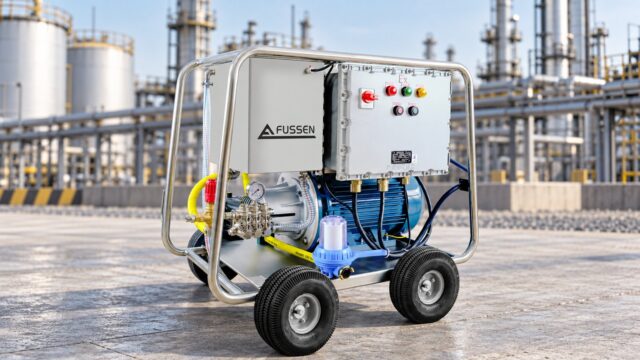
Specify a stainless steel frame (AISI 304 as a minimum, 316 where spray is constant) or a hot-dip galvanised frame with a powder coat for lower-cost units. Fasteners, wheels and lifting eyes should be stainless as well; a stainless frame on carbon-steel bolts fails at the bolts.
Pump heads and valves
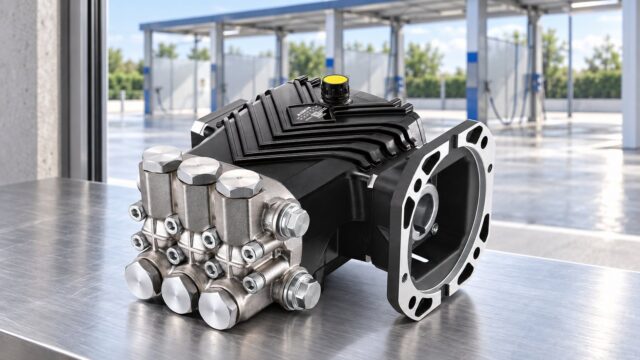
Fussen plunger pumps are offered with brass, nickel-plated brass and stainless steel heads. For fresh water the brass head is proven and economical. For seawater, brackish water or frequent detergent use, the stainless steel head with stainless valves and ceramic plungers is the correct specification. The ceramic plunger itself is inert to chlorides; what fails in a brass pump is the head and the valve seats. The FBS stainless steel plunger pump (200-350 bar, up to 36 L/min) and the FCH stainless steel pump (500-600 bar) are the usual choices for cold-water marine units.
Seals for seawater and hot water
Seal packs are consumables and their material matters. NBR is fine for fresh cold water. For seawater with fine sand, ask for a high-pressure seal pack with a sacrificial low-pressure seal in front of it and a weep return, so abrasive particles are flushed rather than dragged into the main seal. For hot water above 60 °C, FKM (fluoroelastomer) or PTFE-based seals are needed. A supplier should be able to tell you the seal material by part number, not just “standard”.
Water quality and filtration
Whatever the metallurgy, a 50 to 100 micron inlet filter is mandatory when drawing from a harbour, tank or bowser. Sand in the inlet is the single most common cause of valve and seal failure on shipyard machines and it is entirely preventable.
Power on board versus power in the yard
The same cleaning task may be done alongside on ship’s power, in a dry dock on yard power, or on a remote berth with no power at all. Buy for the worst case you expect.
Ship’s electrical supply: 440 V / 60 Hz
Most ocean-going ships have a 440 V, 60 Hz, three-phase supply (some carry 380 V or 690 V). A washer built for 380/400 V, 50 Hz will not simply plug in: at 60 Hz the motor runs 20 % faster, so a direct-driven pump delivers 20 % more flow and the motor draws more power than its rating. Reputable manufacturers wind the motor and select the pulley ratio or pump crank speed for 440 V / 60 Hz, and mark the nameplate accordingly. Order the voltage and frequency explicitly; do not assume it will be “adjusted on site”.
Yard supply: 380-415 V / 50 Hz or 460-480 V / 60 Hz
Long cable runs across a dock cause voltage drop, and a 55 kW UHP unit starting direct-on-line draws six to seven times full-load current. Above 30 kW, specify a soft starter or star-delta starter.
Diesel units for berths and floating docks
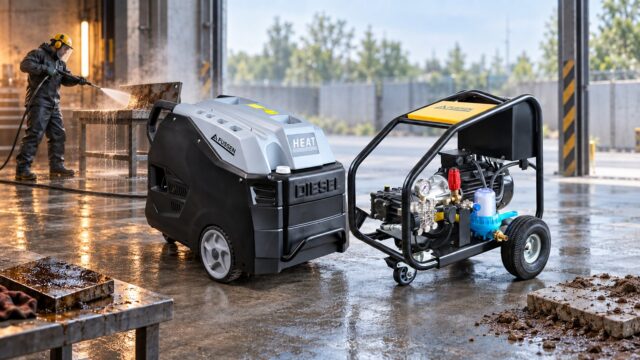
Where power is uncertain, a diesel-driven high pressure washer removes the dependency. The FCD diesel pressure washer covers 350-600 bar at 15-30 L/min for hard-fouling work, and the FKD diesel UHP unit reaches 700-2,800 bar for coating removal without any electrical connection. Check that the fuel tank gives a full shift of running and that exhaust and noise are acceptable in an enclosed dock.
Hot water: burner or electric coil
Fussen hot water units are diesel-fired: a burner heats a coil that the pump discharge passes through, with outlet temperature adjustable up to 90 °C. On board ship, a diesel burner is generally acceptable in a dry dock or on deck, but engine-room use may require the exhaust to be led outside. An electric-heated version avoids combustion entirely and is the right choice where open flames are restricted, at the price of a much higher electrical load.
IMPA membership and what ship chandlers need
The International Marine Purchasing Association (IMPA) maintains the coding system that ship owners and managers use to requisition stores and equipment through chandlers. Fussen is an IMPA supplier member, which matters to a chandler in three practical ways.
- Codified requisitions. A vessel’s purchasing system sends a request by IMPA code and description. A supplier who understands the codes for high pressure cleaners, spare nozzles, hoses and seal kits can quote against the requisition without a long clarification loop.
- Documentation that ships expect. Ships’ safety management systems want a CE declaration, an operator manual in English, a spare parts list with drawings, and material certificates for pressure-bearing parts on request. Fussen holds ISO 9001, 14001 and 45001 and CE certification for its washers, and provides the manual and parts list with each unit.
- Port delivery logistics. Chandlers work to tight vessel schedules. Packing that survives sea freight and forklift handling, a lifting frame with certified eyes, and clear customs documentation reduce the risk of a machine missing the ship.
Spare parts logistics: keeping the machine running in any port
A pressure washer is a piece of rotating equipment with wear parts, and a ship or yard is a poor place to wait weeks for a seal kit. Plan the spares before delivery.
Commissioning spares kit
For each machine, hold on board or in the yard store: two complete high-pressure seal kits, one set of valve assemblies, one set of nozzles in the sizes used (fan and rotating), spare O-rings for the unloader, two inlet filter elements, one high-pressure hose of each length, and a quick-coupling set. For diesel units add fuel filters, air filters and an engine oil change. For hot water units add burner nozzles, a burner electrode set and fuel filters for the boiler.
Standardisation reduces inventory
Fussen’s pump families share components across models. The A series pumps (FAB, FAN, FAS) share a 24 mm solid shaft and a common seal design; the D series stainless pumps (FDH, FDK, FDL) share a 30 mm shaft; the E series (FEH, FEK, FES, FEL) share a 40 mm shaft. A fleet that standardises on one pump family across its deck, hull and tank washers can carry one seal kit reference rather than three.
Service intervals for marine duty
- Pump oil: first change at 50 hours, then every 500 hours or 3 months in a salt atmosphere.
- High-pressure seals: inspect at 500 hours; typical life 800-1,500 hours on clean water, less with sand or seawater.
- Valves: inspect at 1,000 hours or when pressure fluctuates.
- Nozzles: replace when the measured pressure at the gauge drops more than 10 % with the same pump speed, which indicates the orifice has worn open.
- Fresh-water flush of the pump and hose after every seawater use, without exception.
Recommended Fussen series for marine work
The table maps the cleaning tasks above to Fussen machine series. All washers use Fussen triplex ceramic plunger pumps and are available with stainless steel pump heads on request.
| Series | Drive | Pressure | Flow | Best marine use |
|---|---|---|---|---|
| FAE | Electric | 150-250 bar | 15-18 L/min | Decks, superstructure, soft fouling |
| FLE | Electric | 160-200 bar | 40-70 L/min | Chloride wash-down, tank washing, large-area work |
| FCE | Electric | 350-600 bar | 15-22 L/min | Hard fouling, rudder and propeller cleaning |
| FDE | Electric | 500-1,000 bar | 15-36 L/min | Selective antifouling removal, weld preparation |
| FKE | Electric | 600-1,500 bar | 15-40 L/min | Coating removal, hydro-blasting to bare steel |
| FCD | Diesel | 350-600 bar | 15-30 L/min | Hull cleaning at berths without power |
| FKD | Diesel | 700-2,800 bar | 30-150 L/min | UHP coating removal, floating docks, contractors |
| FHP / FHS | Electric pump, diesel burner | 200-250 bar | 15-18 L/min | Engine room, bilge and separator degreasing |
For hull work in a yard with reliable power, the FCE 350-600 bar electric washer is the workhorse: the FCE 22/50 gives 22 L/min at 500 bar, enough for a rotating nozzle on barnacle-fouled plating. Where the specification calls for antifouling removal or surface preparation, move up to the FDE 500-1,000 bar series or the FKE 600-1,500 bar UHP series, which run on D and E series stainless steel pumps built for continuous high-pressure duty. For engine rooms, the FHP and FHS hot water series deliver up to 90 °C at 200-250 bar, the correct combination for fuel oil and grease.
Buyer’s checklist for shipyard cleaning equipment
Safety and environmental points specific to shipyards
- Above roughly 250 bar, operators need water-jetting PPE: waterproof boots with metatarsal protection, a face visor, and for UHP work a jet-resistant suit. The reaction-force calculation earlier tells you when a hand lance is no longer acceptable.
- Removed antifouling contains biocides (copper and co-biocides). Most ports require wash water from hull cleaning to be collected and filtered before discharge. Plan for a collection sump or a closed-loop vacuum recovery head on UHP work.
- In enclosed spaces (tanks, engine rooms), a diesel-driven unit must be positioned outside with the hose led in, or an electric unit used.
Ten points before the purchase order
- List the tasks and match each to a pressure/flow band from the task table. Do not buy one machine for everything.
- Confirm the supply: 440 V / 60 Hz on board, yard voltage in dock, or diesel. Have the nameplate match.
- Specify pump head material: brass for fresh water only; stainless steel for seawater, detergents or hot water.
- Specify frame material and fasteners in stainless or galvanised steel; ask about wheel and lifting-eye corrosion protection.
- Confirm seal material for the water temperature and whether a weep-return low-pressure seal is fitted.
- Check reaction force and hand-held limits; specify foot control or a mechanised head for UHP.
- Order a commissioning spares kit with the machine and confirm part numbers and lead times for follow-on orders.
- Request the CE declaration, English manual and exploded parts drawings before shipment.
- For chandler orders, confirm IMPA codes on the quotation and packing suitable for sea freight and port handling.
- Agree who commissions the unit and trains the crew: a one-day handover prevents most early failures.
If you are specifying cleaning equipment for a dry dock, a fleet or a chandlery catalog, contact the Fussen technical team with your task list, water source and power supply, and we will propose the pump material, seal option and series that fit.
Frequently asked questions
What pressure is needed to remove barnacles from a ship hull?
Hard calcareous fouling such as barnacles usually needs 350 to 600 bar with a rotating nozzle to break the bond without damaging sound antifouling. Soft fouling comes off at 150 to 250 bar with a fan nozzle. Full coating removal to bare steel requires ultra-high-pressure water jetting from 1,500 bar upwards.
Can a pressure washer run on seawater?
Yes, provided it is specified for it: a stainless steel pump head and valves, ceramic plungers, a suitable seal pack and a 50-100 micron inlet filter. Flush the pump and hoses with fresh water after every use. Brass pump heads are not recommended for regular seawater service.
Will a 50 Hz pressure washer work on a ship's 440 V 60 Hz supply?
Not without changes. At 60 Hz the motor runs 20 % faster, so flow and motor load rise by 20 % and the unloader and motor may be overloaded. Order a unit built for 440 V / 60 Hz with the correct pulley or crank speed, or choose a diesel-driven machine that is independent of the supply.
Why use hot water for engine room cleaning instead of higher pressure?
Fuel oil and grease are viscosity problems, not adhesion problems. Water at 70-90 °C lowers their viscosity and allows detergent to emulsify them, so a 200-250 bar hot water unit cleans faster and with less water than a 500 bar cold unit, which mainly spreads the oil.
What does IMPA supplier membership mean for a ship chandler?
It means the manufacturer works within the IMPA coding and requisition system used by ships' purchasing departments, and is set up to supply the documentation, packing and spare parts support that vessels require. It shortens quotation cycles and reduces delivery risk for chandlers.
Need a recommendation?
Get a Quotation and Technical Recommendation Within 24 Hours
Send us your pressure, flow and application. Our engineers reply within 24 hours.

Fussen has designed and manufactured high pressure plunger pumps and industrial washers in Foshan, China since 2001. ISO 9001 / 14001 / 45001, CE and ATEX-certified, exporting to more than 60 countries.