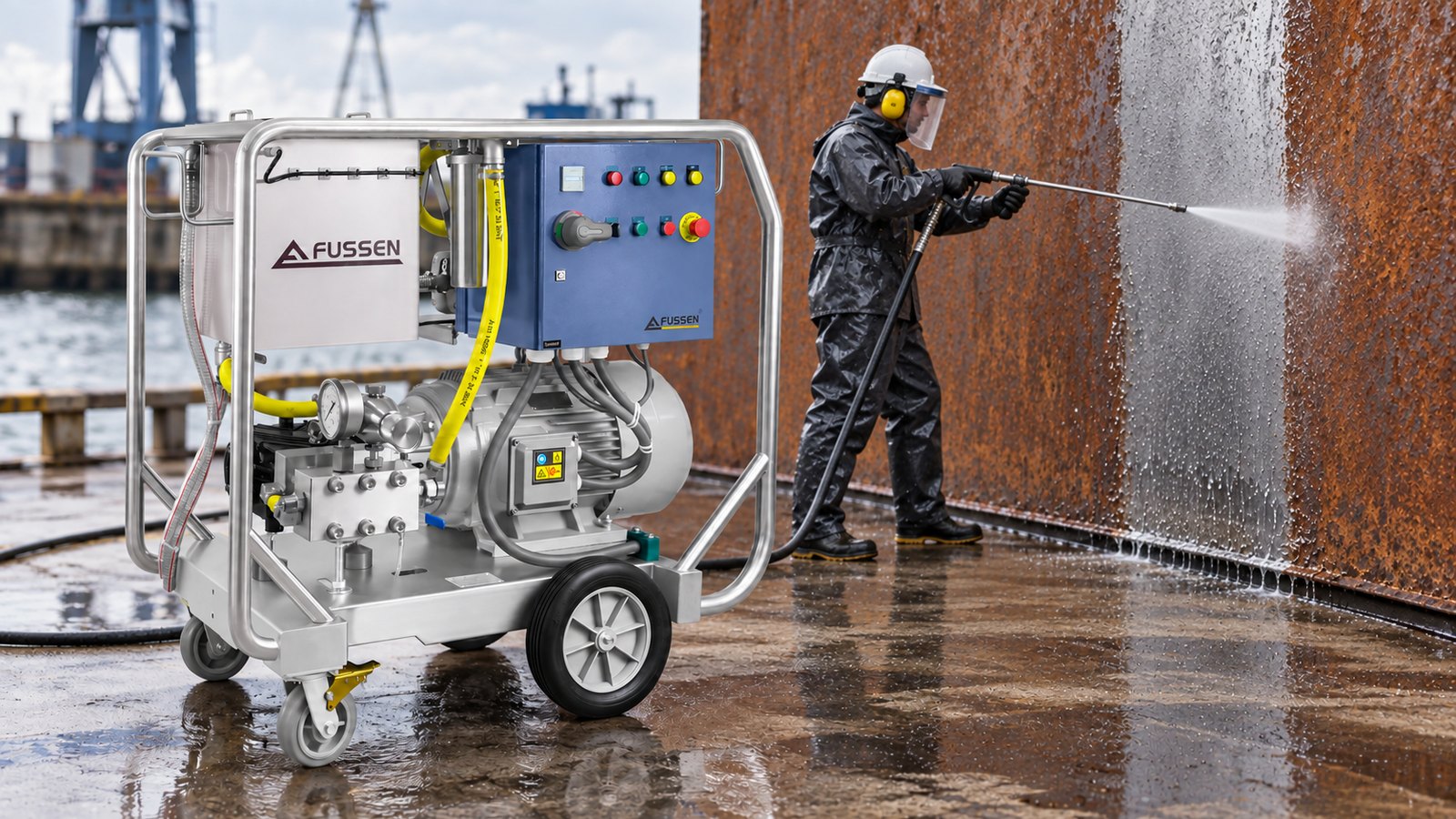
Every coating fails at the surface it was applied to. When a shipyard, tank farm or bridge contractor has to remove rust and old paint before recoating, the choice of method decides the cost of the job, the dust and waste it produces and how long the new coating lasts. Abrasive blasting has been the default for a century, but it is being displaced on many sites by water jetting rust removal: high or ultra-high pressure water, with no abrasive, that strips coatings and corrosion and washes away the soluble salts that grit blasting leaves behind. This guide sets out the pressure classes used in surface preparation water jetting, what each removes, how the visual standards for water-jetted steel work, how hydro blasting compares with sandblasting, and the pumps, nozzles, safety equipment and productivity figures you need for a first estimate.
Water jetting rust removal: pressure classes and what they remove
Water jetting is classified by operating pressure, because pressure determines what the jet can remove. The industry’s joint surface preparation standards describe four classes, given here as typical ranges since national and company definitions differ slightly.
| Class | Typical pressure | Typical flow | What it removes | Fussen equipment class |
|---|---|---|---|---|
| Low pressure water cleaning | Below 350 bar | 15 to 70 L/min | Dirt, loose paint, loose rust, marine growth, salts | FBE, FLE washers |
| High pressure water cleaning | 350 to 700 bar | 15 to 40 L/min | Tight loose rust, chalked and poorly bonded coatings, heavy grease | FCE, FCD washers, FEK pumps |
| High pressure water jetting | 700 to 1,700 bar | 15 to 40 L/min | Most coatings, tight rust scale, weld spatter residue | FDE, FKE, FED washers |
| Ultra-high pressure water jetting | Above 1,700 bar | 10 to 30 L/min | Well-bonded epoxy and polyurethane systems, mill scale-adjacent rust, to bare metal | FKD, FRE washers, FES pumps |
Removal happens when the stagnation pressure of the jet exceeds the bond strength of the material on the surface. Loose rust lifts at a few hundred bar; a chalked alkyd may need 500 bar; a well-applied two-pack epoxy on a blasted profile needs an ultra-high pressure jet. Once the bond is broken, flow matters as much as pressure: it carries debris away and sets the square meters per hour.
Two limits apply to all classes. Water alone does not remove mill scale, which is fused to the steel, and it does not cut a new anchor profile into the metal. Both points are central to the comparison with abrasive blasting later in this article.
Standards for water-jetted steel: WJ-1 to WJ-4 and flash rust
Because water leaves a different appearance from grit, the joint standard for water jetting of steel defines its own visual cleanliness grades, separate from the abrasive blast grades. Specifiers should call up the water jetting grade explicitly.
Cleanliness grades
- WJ-1, clean to bare substrate. All visible rust, coating and foreign matter removed; the most demanding grade, comparable in intent to a white metal blast.
- WJ-2, very thorough or substantial cleaning. Free of visible rust and coating except for randomly dispersed stains or traces of tightly adherent material over a small proportion of the area.
- WJ-3, thorough cleaning. Tightly adherent residues may remain over a larger proportion of the area, provided the remainder is clean.
- WJ-4, light cleaning. All loose rust, coating and foreign matter removed; tightly adherent material may remain. Typical of maintenance washing before a surface-tolerant recoat.
The standard also recognizes levels of non-visible contamination, covering chlorides and other soluble salts, tested chemically after cleaning. Water jetting is notably good at reducing these salts, a strong argument in marine and chemical plant work.
Flash rust grades
Steel cleaned with water begins to oxidise as it dries. The standard describes three flash rust levels, broadly light (a faint tint that does not mark a wiped cloth), moderate (a visible layer that lightly marks a cloth) and heavy (a loosely adherent layer that hides the original surface). Most coating manufacturers accept light flash rust and some accept moderate; the specification should state the permitted grade and the coating supplier should confirm it. Flash rust is slowed by clean, low-chloride water, quick drying with dry air, and coating within the window the paint supplier allows.
Hydro blasting vs sandblasting: a practical comparison
Neither method is universally better. The table sets out where each wins.
| Factor | Water jetting (700 to 2,800 bar) | Abrasive blasting |
|---|---|---|
| Airborne dust | None; debris captured in water | High; containment and respiratory protection needed |
| Waste volume | Water plus removed coating only | Removed coating plus 20 to 60 kg of spent media per m² on heavy work |
| Hazardous waste handling | Filter the water, dispose of the solids | Entire media volume may be contaminated (lead, chromate) |
| Anchor profile | Restores the existing profile; cuts no new one | Creates a fresh profile of 40 to 100 µm |
| Mill scale removal | No | Yes |
| Soluble salt removal | Very good | Poor; salts remain in pits |
| Work near machinery, bearings, electrics | Water ingress risk; needs masking | Grit ingress risk; needs masking |
| Consumables per shift | Water, nozzle wear | Media, nozzle liners, compressor fuel |
| Typical productivity, single operator | 5 to 20 m²/h depending on coating and pressure | 10 to 30 m²/h on open steel |
| Capital cost of unit | Higher per unit | Lower per unit, but compressor and containment add up |
Dust and containment
Dry blasting generates fine dust plus pulverised coating, which on older structures can contain lead or chromates. Containment, extraction and respiratory protection often cost more than the blasting itself. Water jetting produces no airborne dust; the removed material stays wet and is collected by vacuum or filtered from the run-off. On a working ship, a refinery or a bridge over a river, this alone can decide the method.
Media disposal
A crew removing a 300 µm coating from 500 m² of steel may consume 15 to 30 tonnes of expendable media, all of which must be collected, tested and disposed of together with the old coating. Water jetting produces only the coating solids and water that can be filtered and recycled. Waste tonnage is typically reduced by more than 90 percent.
Anchor profile
This is the argument for abrasive blasting. New steel and steel with mill scale must be blasted to create the anchor profile; water cannot do it. On previously blasted and coated steel, however, the original profile is still there beneath the coating, and ultra-high pressure water exposes it intact. Most maintenance recoating therefore needs no new profile.
Speed and cost
On open, flat steel, blasting is generally faster per operator hour. Water jetting catches up once containment, set-up, media handling and clean-up are counted. On total cost, water jetting tends to win on repeat maintenance of coated steel, in confined or occupied areas and where waste disposal is expensive; abrasive blasting wins on new steel, mill scale and jobs that require a new profile.
Equipment: pumps and washers for water jetting
The pump is the heart of the system. Pressure sets what can be removed; flow sets the cleaning rate.
Plunger pumps for OEM jetting units
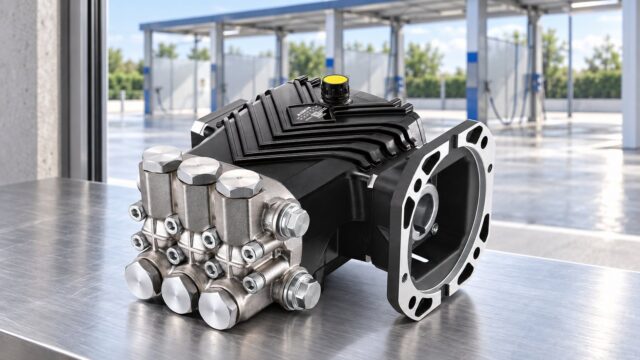
Fussen’s D and E series stainless steel plunger pumps are built for this duty. The FDH series covers 800 to 1,000 bar at 15 to 20 L/min on a 30 mm solid shaft, suitable for compact 1,000 bar units. The FEH series on a 40 mm shaft runs 800 to 1,200 bar at 20 to 25 L/min, the FES series reaches 1,500 to 2,000 bar at 10 to 15 L/min for ultra-high pressure coating removal, and the FEK series provides 450 to 750 bar at 30 to 50 L/min where flow rather than pressure is the priority, such as marine growth and loose rust removal on hulls. The FFS-G gearbox pumps extend to 1,500 bar at up to 65 L/min for high-productivity trailer units. All use ceramic plungers and stainless heads, essential where the water may be brackish.
Complete washers
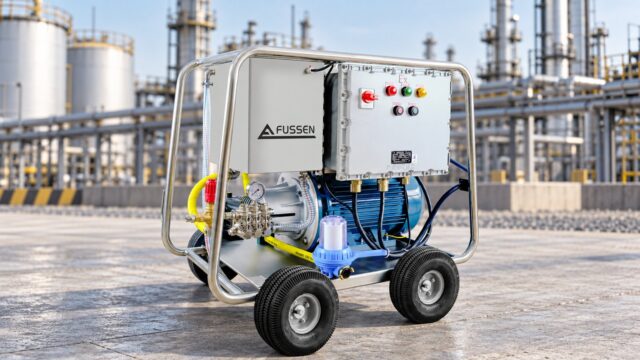
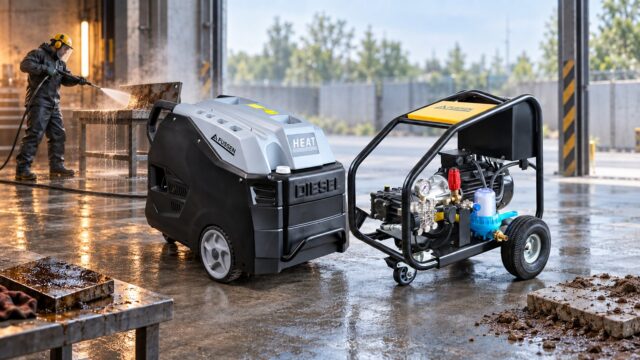
For contractors who need a ready-to-run unit, the FDE series electric washers span 500 to 1,000 bar at 15 to 36 L/min, with the FDE 15/100 and FDE 18/100 covering the 1,000 bar class for coating removal on a three-phase supply. The FKE series extends to 1,500 bar with models such as the FKE 15/150 and FKE 20/100. Where mains power is not available, the diesel-driven FKD series reaches 2,800 bar with the FKD 30/280 and 30/250, or trades pressure for flow with the FKD 120/100 and FKD 150/70 for large-area work. Explosion-proof FDE-EX versions, covered by Fussen’s EU ATEX type-examination, are available for refineries and tankers.
Choosing pressure versus flow
A useful rule: pick the lowest pressure that reliably breaks the bond of the material you must remove, then buy as much flow as the power source allows at that pressure. Hydraulic power is pressure multiplied by flow; at a fixed motor size, a higher pressure pump delivers less flow and covers fewer square meters per hour. A 1,000 bar, 18 L/min unit needs roughly 37 kW at the shaft; the same motor delivers about 36 L/min at 500 bar. If the coating lifts at 500 bar, the second machine will strip nearly twice the area per hour.
Nozzle and gun selection
At jetting pressures the nozzle is a precision part, and the choice of head changes productivity more than any other variable.
- Single fixed jet (0°). Highest impact per unit width, narrowest path. Used for cutting through very tough coatings, cleaning weld seams and getting into corners. Slow on open areas.
- Fan jets (15° to 25°). Below about 500 bar, fan jets are the general-purpose choice for rust and loose coating removal. Above that pressure the fan loses coherence quickly and stand-off distance becomes critical.
- Rotating nozzles. Two or more 0° orifices on a head that spins at several thousand rpm, driven by the reaction of the jets. This is the standard tool for coating removal at 700 bar and above: pencil-jet impact with a uniform path 20 to 50 mm wide.
- Surface cleaners and crawlers. For decks, tank floors and hull plating, a rotating head under a shroud with vacuum recovery of the water. 20 to 40 m²/h on flat plate is achievable at 1,000 bar and above, with far lower operator fatigue.
Size the orifices from the pump flow and target pressure using a nozzle chart, exactly as for a conventional washer: total orifice area must pass the pump’s full flow at the working pressure. Guns for jetting above 700 bar use a dump valve that returns the pump to low pressure the instant the trigger is released. Reaction force rises with both pressure and flow; keep it below about 250 N for hand-held work and use a supported gun above that.
Safety: PPE, hoses and working practice
A jet at 1,000 bar will cut through a steel-toed boot. Injection injuries look trivial on the surface and are frequently life-changing, because water and debris are driven deep into tissue.
- PPE. Jetting-rated suits, gaiters and gloves tested to a stated pressure and flow, a full-face visor and hearing protection. Standard rain gear offers no protection.
- Hoses and fittings. Use hose with a rated working pressure at least equal to the pump’s maximum, with a burst safety factor of 2.5 or more, and inspect it before every shift for cuts, kinks and cover damage. Fit whip restraints on every hose joint above 350 bar.
- Pressure relief. A safety relief valve independent of the unloader, set no more than 10 percent above working pressure, is mandatory. Verify it before each job.
- Exclusion zone. A physical barrier around the work area; nobody inside but the operator, with a second person at the pump able to stop it immediately.
- Foot control and dead-man operation. Every gun and lance must return to a safe, low-pressure state when the operator releases it.
- Training. Operators should be trained and assessed for the pressure class they use, with records kept.
- Environment. Collect run-off when removing lead or chromate coatings, filter it, and test the solids before disposal.
Productivity estimates: rules of thumb
Treat these figures as starting points for a quotation, to be confirmed by a trial patch. They assume a trained operator with a rotating nozzle and include normal breaks but not set-up.
| Task | Pressure | Flow | Typical rate per operator |
|---|---|---|---|
| Marine growth and loose rust, hull plate | 350 to 500 bar | 30 to 50 L/min | 40 to 80 m²/h |
| Loose and chalked coating, WJ-4 to WJ-3 | 500 to 700 bar | 20 to 40 L/min | 15 to 30 m²/h |
| Single alkyd or chlorinated rubber coat, to WJ-2 | 700 to 1,000 bar | 15 to 25 L/min | 8 to 15 m²/h |
| Multi-coat epoxy, 300 to 500 µm, to WJ-2 | 1,500 to 2,800 bar | 10 to 20 L/min | 3 to 8 m²/h |
| Flat deck with vacuum surface cleaner, epoxy removal | 1,000 to 2,500 bar | 15 to 30 L/min | 15 to 30 m²/h |
Water consumption follows from the flow: a 20 L/min unit running a six-hour effective shift uses about 7 m³. Rates fall sharply on complex geometry such as stiffened frames and pipe racks, where 40 to 60 percent of the flat-plate rate is realistic, and rise on coatings that have already begun to fail. Always time a trial on one square meter; that number, adjusted for access, is a better basis for a price than any table.
Specifying a water jetting system
Define the coating to be removed, the required cleanliness grade, the permitted flash rust level, the area and its geometry, and the power available on site. The pressure class follows, and flow is then chosen to hit the target productivity within the available power. Fussen can supply bare D and E series pumps for OEM units and complete FDE, FKE and FKD washers for contractors, in electric, diesel and ATEX explosion-proof versions. Send your coating data and site conditions through our contact page and our engineers will recommend a pump, nozzle configuration and drive package for the job.
Frequently asked questions
Can water jetting replace sandblasting completely?
For maintenance recoating of previously blasted steel, usually yes. For new steel with mill scale, or where the specification requires a new anchor profile, abrasive blasting is still needed.
What pressure is needed to remove rust with water?
Loose rust lifts at 200 to 350 bar. Tightly adherent rust needs 700 bar or more, and rust in pits on heavily corroded steel may need ultra-high pressure above 1,700 bar to reach WJ-2.
Does flash rust ruin the surface?
Light flash rust is accepted by most coating manufacturers and moderate by some. Clean water, fast drying and a short window before coating keep it within limits; the coating supplier should confirm the permitted grade.
How much water does high pressure jetting use?
A 15 to 25 L/min jetting unit uses roughly 5 to 9 cubic meters per effective six-hour shift. Recovery and filtration systems allow much of this to be recycled.
Is ultra-high pressure jetting safe for the steel itself?
Yes. Water does not erode sound steel at these pressures in the dwell times used for coating removal; it removes only material that is weaker than the jet's impact.
Need a recommendation?
Get a Quotation and Technical Recommendation Within 24 Hours
Send us your pressure, flow and application. Our engineers reply within 24 hours.

Fussen has designed and manufactured high pressure plunger pumps and industrial washers in Foshan, China since 2001. ISO 9001 / 14001 / 45001, CE and ATEX-certified, exporting to more than 60 countries.