Most buyers choose an industrial high pressure washer by looking at one number: the maximum bar rating. Then the machine arrives, it strips paint that should have stayed on, it takes twice as long as expected to flush a heat exchanger, and the site electrician discovers that the 400 V supply cannot feed it without a new breaker. None of these problems are caused by a bad machine. They are caused by a purchase decision that ignored flow, power supply, pump materials and the real cost of running the unit for five years. This guide explains how pressure, flow and power relate to each other, how to match them to your actual cleaning task, and what to check on the frame, hose and pump head before you sign off. It ends with a ten-point checklist you can hand to a purchasing team. The numbers used throughout are physics and standard engineering rules of thumb, not marketing figures.
Pressure and flow: two numbers, two different jobs
A high pressure washer does two things at once. Pressure (bar) decides how hard the water hits the surface and therefore whether it can break the bond between the dirt and the substrate. Flow (liters per minute, L/min) decides how much loosened material is carried away per second and therefore how fast the job gets done.
The distinction matters because the two are not interchangeable. Doubling pressure will not help if the problem is a large surface covered in loose mud; that is a flow job. Doubling flow will not help if the problem is a thin, well-bonded layer of scale; that is a pressure job. In practice:
- Pressure is set by the nozzle orifice and limited by the pump and unloader valve. It determines impact force at the surface, which falls quickly with stand-off distance.
- Flow is fixed by the pump displacement and motor speed. A triplex plunger pump is a positive-displacement machine: at a given rpm it delivers the same L/min whether the nozzle is large or small. Fit a smaller nozzle and pressure rises; fit a larger nozzle and pressure falls.
This is why an industrial high pressure washer is specified as a pair, and why Fussen model codes carry both numbers: an FBE 15/30 delivers 15 L/min at 300 bar, an FCE 22/50 delivers 22 L/min at 500 bar.
Cleaning units: a quick way to compare machines
Because both numbers count, a common shortcut is to multiply them. The product, often called “cleaning units”, is proportional to the hydraulic energy delivered per minute:
Cleaning units = bar × L/min
A 150 bar / 15 L/min machine scores 2,250; a 250 bar / 18 L/min machine scores 4,500; a 500 bar / 22 L/min machine scores 11,000. The metric is useful for ranking machines of similar type, but it hides the ratio. Two machines can both score 4,500 (300 bar × 15 L/min and 150 bar × 30 L/min) and behave completely differently on the job. Use cleaning units to shortlist, then use the ratio to decide.
Matching pressure and flow to the task
The table gives typical working ranges for common industrial cleaning tasks. They are field starting points; substrate condition, water temperature and detergent shift the numbers.
| Task | Typical pressure (bar) | Typical flow (L/min) | Comment |
|---|---|---|---|
| Vehicle and fleet washing | 100–150 | 10–15 | Paint-safe; flow matters more than pressure |
| Food plant floors and equipment | 100–200 | 15–20 | Often hot water; stainless pump head preferred |
| Construction plant, mud and concrete residue | 150–250 | 15–21 | Higher flow shortens rinse time |
| Ship hull and deck cleaning (marine growth) | 250–350 | 15–21 | Salt water exposure; corrosion-resistant wetted parts |
| Heat exchanger and tube bundle cleaning | 350–600 | 15–22 | Tube lances and rotating nozzles |
| Paint and coating removal, rust | 500–1,000 | 15–36 | Rotary nozzles; operator protection essential |
| Concrete hydrodemolition, thick scale, tank cleaning | 1,000–2,800 | 30–150 | Water jetting rather than washing; dedicated safety systems |
Three rules follow:
- Buy for the hardest routine task, not the occasional extreme. If 90% of the work is fleet washing at 150 bar, hire a 500 bar unit for the one job a year that needs it.
- Do not over-pressure a sensitive substrate. Above roughly 200 bar you begin to damage vehicle paint, timber and soft masonry; above 350 bar you can cut into concrete laitance. More bar is not automatically better.
- Add flow before adding pressure for large areas. For decks, yards and building facades, a 200 bar / 40 L/min machine such as an FLE series high-flow electric washer will outperform a 350 bar / 15 L/min unit by a wide margin because it sweeps a wider path.
Reading the nozzle chart
Pressure at the surface depends on the nozzle. At 150 bar, a size 03 nozzle (1.09 mm orifice) passes about 8.3 L/min while a size 05 (1.35 mm) passes about 14 L/min. If your pump delivers 15 L/min and you fit a size 03, the unloader valve will bypass roughly 7 L/min back to the inlet and the pump will run hot for nothing. Match the nozzle to the pump flow at working pressure so all the water goes through the nozzle; this is the most common set-up mistake in the field.
Electric power supply: single phase, three phase and the kW you really need
The electric motor is the first constraint most sites hit. The shaft power required by the pump is straightforward to estimate:
P (kW) ≈ bar × L/min ÷ 600 ÷ η
where η is the overall efficiency of the pump and drive, typically 0.85–0.90 for a direct-coupled triplex plunger pump in good condition. The factor 600 converts bar × L/min into kW.
- 150 bar × 15 L/min = 2,250 ÷ 600 = 3.75 kW hydraulic → about 4.2–4.4 kW at the motor shaft.
- 300 bar × 15 L/min = 4,500 ÷ 600 = 7.5 kW hydraulic → about 8.3–8.8 kW at the shaft.
- 500 bar × 22 L/min = 11,000 ÷ 600 = 18.3 kW hydraulic → about 20–22 kW at the shaft.
- 1,000 bar × 36 L/min = 36,000 ÷ 600 = 60 kW hydraulic → about 67–70 kW at the shaft.
The consequence for the power supply is direct:
- Single-phase 230 V can realistically supply about 3 kW continuously on a 16 A circuit. That caps a single-phase industrial washer at roughly 150 bar / 12 L/min or 120 bar / 15 L/min. Anything above that on single phase will trip breakers or overheat cables.
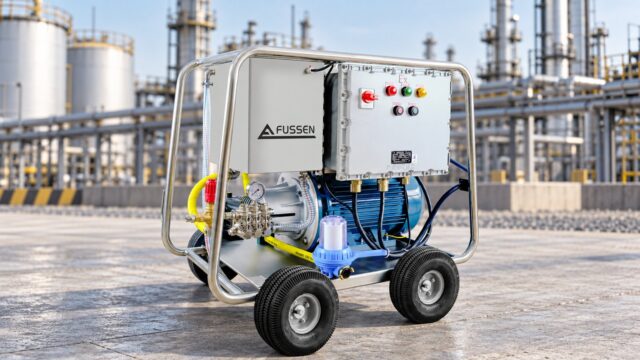
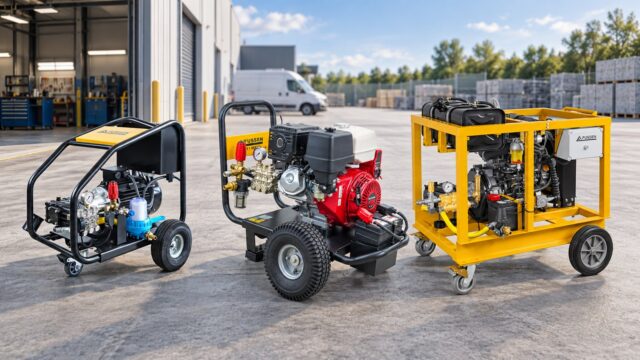
- Three-phase 400 V supplies 4 kW to 75 kW and more without difficulty. Every Fussen electric washer above the entry range, from the FAE series (150–250 bar) through the FBE series (250–350 bar) to the FCE series (350–600 bar), is designed around a three-phase motor.
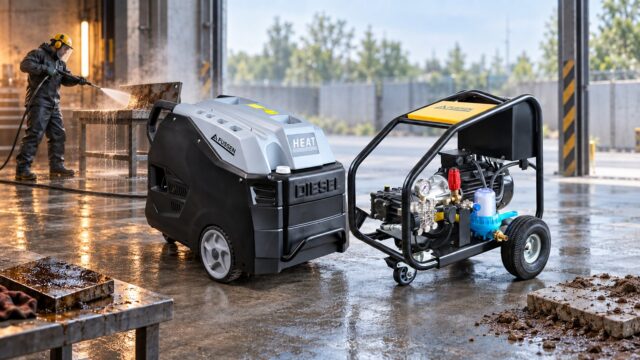
Before you order, ask the site electrician for the voltage and frequency (400 V / 50 Hz in most of Europe, Asia and Africa; 480 V / 60 Hz in North America), the breaker rating at the socket, and the cable length from the distribution board. A 22 kW motor pulls in the region of 40 A at 400 V under full load, and its direct-on-line starting current can be six to eight times that for a fraction of a second. Star-delta or soft-start units reduce the inrush; specify one on motors of 15 kW and above, and a continuous-duty (S1) rating with IP55 protection on any motor. If the supply is marginal or unavailable, an engine-driven washer may be the better answer; the FBG gasoline and FBD diesel ranges cover the same pressure classes without any mains connection.
Frame, wheels, hose and reel: the parts that decide daily usability
An industrial high pressure washer is moved constantly. A machine that is awkward to move gets left in one place, and the operator then over-stretches the hose, which is how hoses fail.
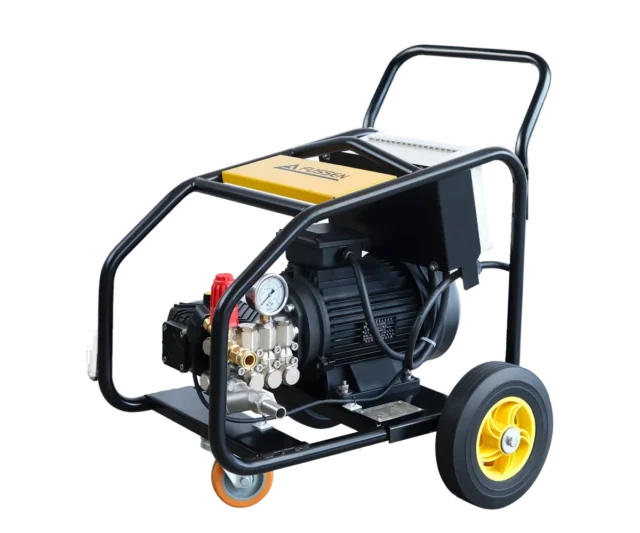
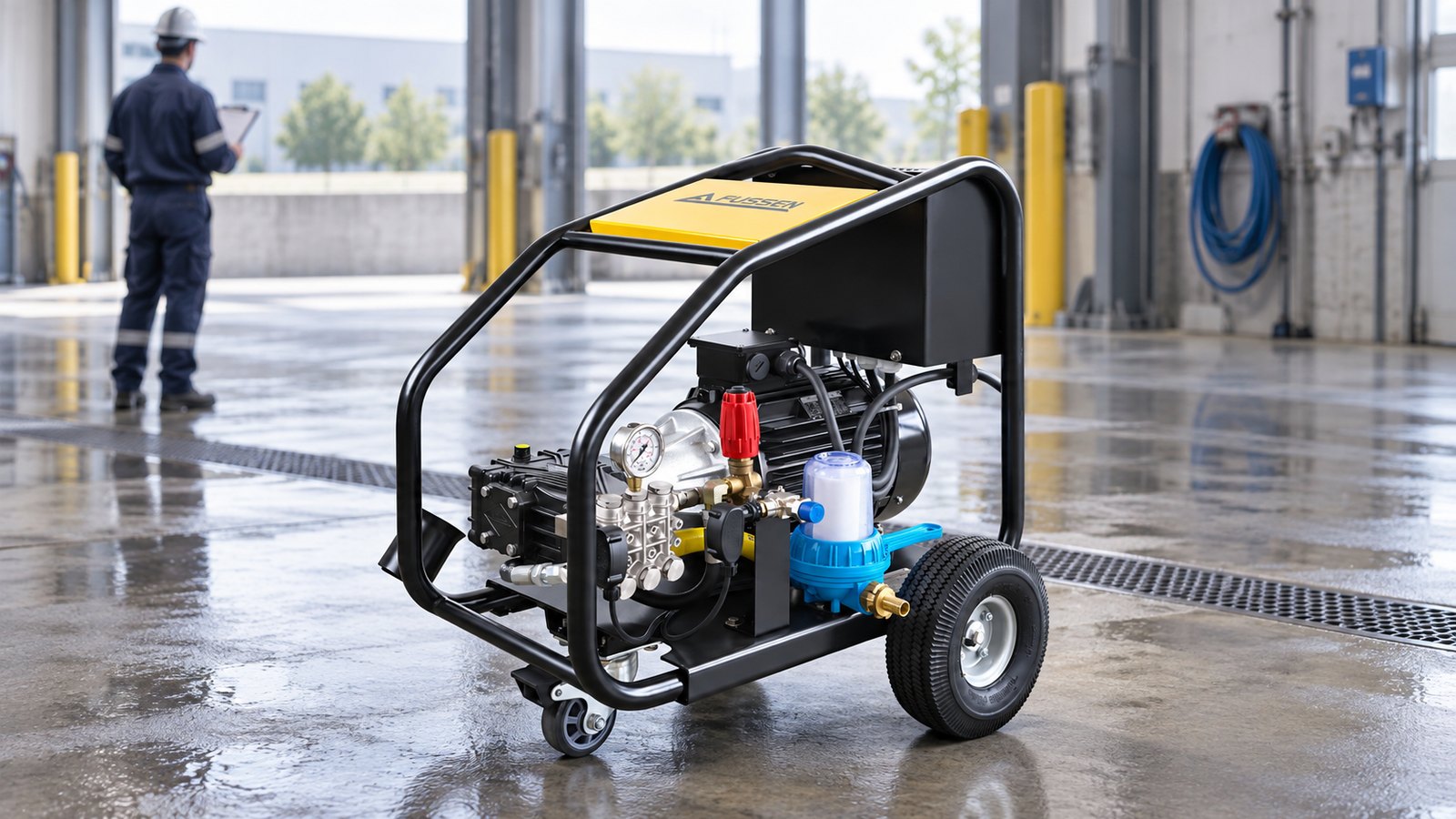
- Frame. Look for a welded steel tubular frame with the pump and motor mounted low. A powder-coated or galvanised frame resists the wet, chemical-laden environment far better than painted sheet metal. A lifting eye or forklift pockets are worth having on any unit above about 150 kg.
- Wheels and tires. Pneumatic or solid puncture-proof tires of at least 250–300 mm diameter roll over hoses, cables and gravel. Two fixed wheels plus a parking brake is the minimum for a 60 kg unit; four wheels with a steering handle for anything heavier.
- Hose. Specify the hose working pressure at 1.5× the machine’s maximum and the burst pressure at 4× or better. Two-wire steel braid is standard up to 350 bar; use four-spiral or thermoplastic hoses above that. Length matters: every extra 10 m of 3/8-inch hose costs a few bar of pressure at 15 L/min, and 20 m is a practical maximum before you need a larger bore.
- Hose reel. A reel keeps the hose off the floor, prevents kinks and roughly doubles hose life in fleet and food-plant use.
- Controls and protection. Pressure gauge (glycerine-filled), unloader valve with an adjustable working pressure, thermal relief or bypass timer so the pump does not overheat during trigger-off periods, and a motor overload relay.
Pump head material: brass, nickel-plated brass or stainless steel
The pump manifold (the “head”) is the wetted component that determines how long the machine survives your water and your chemicals. Fussen builds its triplex ceramic plunger pumps in three manifold materials, and the same choice applies to the pumps inside its washers.
| Manifold material | Typical use | Strengths | Limitations | Fussen pump examples |
|---|---|---|---|---|
| Forged brass | Clean fresh water, general industrial cleaning | Lowest cost, good thermal conductivity, easy to machine and repair | Dezincification and pitting in salt water, sensitivity to acidic or chlorinated chemicals | FAB series (120–250 bar), FBB, FCB |
| Nickel-plated brass | Detergent-heavy applications, light chemical exposure, coastal sites | Corrosion barrier on all wetted surfaces at modest extra cost | Plating can be damaged by abrasive particles or aggressive acids | FAN series, FBN, FCN |
| Stainless steel | Sea water, hot water, food and pharmaceutical plants, chemical injection, high pressure above 600 bar | Full chemical and salt water resistance, hygiene, highest pressure ratings | Highest cost and weight; longer lead times on some sizes | FAS series, FBS, FCH, all D and E series pumps |
A simple decision rule: if the machine will ever see salt water, hot water above 60 °C, or a pH outside 6–9, specify stainless steel and do not look back. The extra cost of the manifold is small compared with a pump rebuild after 500 hours. For everything else, forged brass is a proven, economical choice, and nickel plating is the sensible middle ground for wash-down with detergents.
Also confirm ceramic plungers rather than hardened steel (ceramic resists abrasion and keeps its seal surface for thousands of hours) and a crankcase sight glass and drain the operator can reach.
Total cost of ownership over five years
The purchase price of an industrial high pressure washer is typically a minority of what it costs to own it. A realistic five-year model for a 300 bar / 15 L/min electric unit used 1,000 hours a year includes:
- Energy. A 9 kW motor running 1,000 hours a year consumes about 9,000 kWh. At a commercial tariff this is a recurring cost of the same order as the purchase price over five years. Efficiency (η) is not a small number in the formula.
- Water. 15 L/min × 60 min × 1,000 hours = 900 m³ per year. Where water is metered and effluent is charged, this is a real line item; a higher-pressure, lower-flow machine can reduce it for suitable tasks.
- Consumables. Nozzles (worn nozzles lose pressure; replace when the gauge drops 10%), pump seals and valves (typically every 500–1,500 hours depending on water quality), crankcase oil (every 300–500 hours), hoses and quick couplings.
- Downtime. A machine that is out of service costs the labour of the crew standing next to it. Spare parts availability and the ability to rebuild the pump on site matter more than a few percent on the initial price.
When comparing quotations, ask for seal kit and valve kit prices and service intervals, convert five years of consumables, energy and water into a cost per hour, and compare that figure rather than the purchase price.
Ten-point checklist before you order
- Working pressure matches the hardest routine task, with headroom of 10–20% but no more.
- Flow rate suits the area to be covered; for large surfaces, flow before pressure.
- Nozzle sizes are selected from the chart so that full pump flow passes through the nozzle at working pressure.
- Motor power calculated as bar × L/min ÷ 600 ÷ η, and the site supply (phase, voltage, frequency, breaker rating) confirmed in writing.
- Soft starter or star-delta on motors of 15 kW and above; IP55 motor protection minimum.
- Pump head material chosen for the water and chemicals: brass, nickel-plated brass or stainless steel.
- Ceramic plungers, accessible crankcase oil sight glass and drain, adjustable unloader, thermal relief valve.
- Hose working pressure 1.5× machine maximum, appropriate braid or spiral construction, length no more than the job requires, mounted on a reel.
- Frame, wheels, brake and lifting points suited to the terrain and the machine’s weight.
- Seal kit, valve kit and nozzle prices, service intervals and spare-parts lead times quoted with the machine, and CE marking or the certification your region requires.
If you would like help sizing a machine for a specific task, send the substrate, the area, the water source and the site power supply to Fussen’s engineering team through the contact page and we will recommend a pressure and flow combination and the right pump material.
Frequently asked questions
What pressure does an industrial high pressure washer need?
It depends on the substrate. Vehicle and general cleaning works at 100–150 bar, construction and marine growth at 150–350 bar, heat exchangers at 350–600 bar, and coating removal at 500–1,000 bar. Buy for your hardest routine task and avoid over-pressuring sensitive surfaces.
Is flow rate or pressure more important?
Both. Pressure determines whether the dirt is dislodged; flow determines how quickly it is rinsed away. For large areas, extra flow saves more time than extra pressure. Compare machines by bar × L/min, then check the ratio suits the job.
Can I run an industrial washer on a single-phase 230 V supply?
Only up to about 3 kW, which corresponds to roughly 150 bar at 12 L/min. Above that you need a 400 V three-phase supply or an engine-driven unit.
How do I calculate the motor size?
Use P (kW) ≈ bar × L/min ÷ 600 ÷ η with η between 0.85 and 0.90. A 300 bar / 15 L/min pump needs about 8.5 kW at the shaft, so a 9–11 kW motor with a continuous-duty rating.
Which pump head material should I choose?
Forged brass for clean fresh water, nickel-plated brass where detergents or light chemicals are used, and stainless steel for sea water, hot water, food or chemical plants and pressures above 600 bar.
Need a recommendation?
Get a Quotation and Technical Recommendation Within 24 Hours
Send us your pressure, flow and application. Our engineers reply within 24 hours.

Fussen has designed and manufactured high pressure plunger pumps and industrial washers in Foshan, China since 2001. ISO 9001 / 14001 / 45001, CE and ATEX-certified, exporting to more than 60 countries.