The electric vs gas pressure washer question is usually asked the wrong way round. Buyers start with a preference for one power source and then try to make the site fit it. The result is a diesel unit idling inside a food plant, or an electric machine sitting unused beside a road-maintenance truck because there was never going to be a 400 V socket on the hard shoulder. The power source of an industrial pressure washer is not a matter of taste; it is decided by three facts about where the machine will work: whether mains power is available and how much, whether the machine will be used indoors or in a confined space, and how far it has to travel between jobs. This guide compares electric, gasoline (petrol) and diesel drives on the criteria that matter to a B2B buyer, explains where each one wins, and finishes with a decision sequence you can apply to your own fleet in a few minutes.
Electric vs gas pressure washer vs diesel: the comparison at a glance
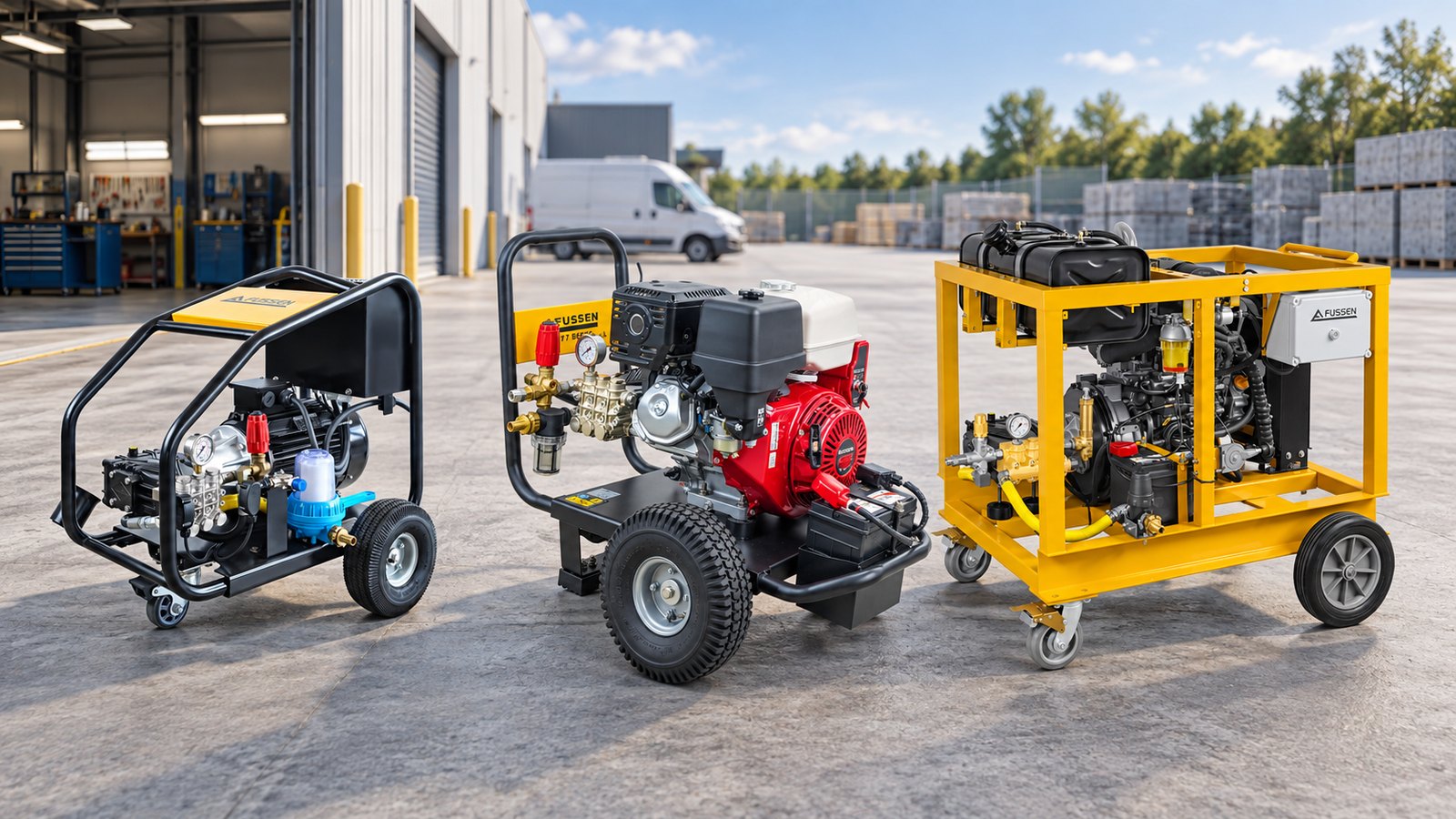
All three drives turn the same kind of triplex ceramic plunger pump; what differs is what turns it, and that decides how the machine is used.
| Criterion | Electric motor | Gasoline engine | Diesel engine |
|---|---|---|---|
| Typical power range | 3–75 kW and above (three-phase); up to ~3 kW on single phase | 4–30 kW | 10–300 kW |
| Pressure / flow range (Fussen) | 100–2,800 bar, 10–150 L/min | 150–500 bar, 15–35 L/min | 150–2,800 bar, 15–150 L/min |
| Mobility | Limited by cable length and socket location | Fully independent; light enough to lift into a van | Fully independent; heavier, often trailer- or skid-mounted |
| Noise at operator position | Lowest (pump noise only, typically 75–85 dB(A)) | High (engine plus pump, often 95–105 dB(A)) | Highest without an enclosure; canopied units are quieter |
| Energy cost per hour | Lowest; electric motors are 85–95% efficient | Highest; small engines are 20–30% efficient and gasoline is expensive | Between the two; diesel engines reach 35–45% efficiency |
| Indoor and confined-space use | Yes | No (carbon monoxide) | No, unless exhaust is ducted outside and ventilation verified |
| Maintenance | Pump only; motor is essentially maintenance-free | Pump plus engine oil, filter, spark plug, carburettor | Pump plus engine oil, fuel and air filters, injectors, cooling |
| Start-up | Instant, any temperature | Recoil or electric start; fuel deteriorates in storage | Electric start; glow plugs needed in cold weather |
| Explosion-proof option | Yes (ATEX motors and controls) | No | Only with spark-arrestor and special engine, rarely economical |
| Purchase price (same pressure class) | Lowest | Middle | Highest |
The pattern is consistent: electric wins on cost, noise and cleanliness whenever mains power exists, gasoline wins on portability at modest power, and diesel wins on fuel economy and durability when a large engine-driven unit has to run all day away from the grid.
When an electric pressure washer wins
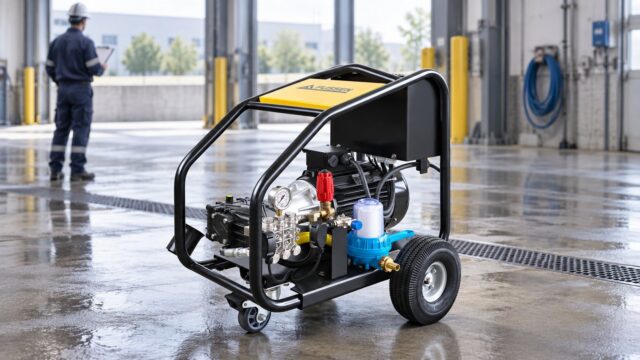
An electric high pressure washer is the default choice for any fixed or semi-fixed location: workshops, vehicle depots, food and beverage plants, factories, wash bays, shipyards with shore power, and any indoor space. The advantages are concrete:
- Running cost. The shaft power needed by the pump is P (kW) ≈ bar × L/min ÷ 600 ÷ η. For a 250 bar / 18 L/min machine that is about 8.5 kW at the shaft, roughly 9.5 kW from the mains. An engine delivering the same shaft power burns fuel worth several times the cost of that electricity per hour.
- No exhaust, no fumes, no fuel storage. Carbon monoxide from a small engine in a closed wash bay reaches dangerous levels within minutes.
- Noise. Removing the engine typically cuts the sound level at the operator by 15–20 dB(A), which in practice means the difference between mandatory hearing protection for everyone in the area and normal conversation a few meters away.
- Maintenance. An induction motor has one pair of bearings and no consumables; the service schedule is the pump’s alone.
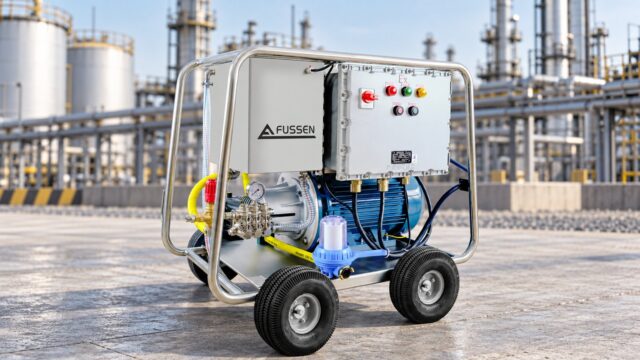
- Explosion-proof versions. In refineries, chemical plants, paint shops and tank farms, only an electric drive can be certified for hazardous zones. Fussen’s ATEX-certified FAE-EX, FBE-EX, FCE-EX and FDE-EX series cover 150 to 1,000 bar for exactly this reason; an engine-driven unit can never be brought into a Zone 1 or Zone 2 area.
Fussen’s electric range runs from the FSE series (100–150 bar) for light duty, through the FAE (150–250 bar) and FBE series (250–350 bar) that make up most industrial cleaning, to the FCE series (350–600 bar) for exchanger and surface-preparation work, and on to FDE, FKE and FRE units at 1,000 to 2,800 bar for water jetting.
The single-phase 230 V limit
The most common reason an electric machine disappoints is that it was ordered for a single-phase supply. A 230 V / 16 A socket delivers about 3.5 kW at most, roughly 3 kW at the pump shaft after motor efficiency and margin. In the power formula:
- 3 kW × 600 × 0.88 ≈ 1,580 bar·L/min of hydraulic capacity.
- That is about 150 bar at 10.5 L/min, or 130 bar at 12 L/min, or 105 bar at 15 L/min.
In other words, single phase covers the FSE class and nothing above it. A 32 A single-phase circuit stretches the limit to about 6 kW, which reaches the lower FAE models, but such circuits are rare on customer sites. If a job needs 250 bar at 15 L/min or more, you need either three-phase power or an engine.
400 V three-phase: what it unlocks
A 400 V three-phase supply removes the power ceiling for all practical purposes. A 16 A three-phase outlet supports motors up to about 7.5 kW, a 32 A outlet up to about 15 kW, and a 63 A outlet up to about 30 kW. Fussen’s 500 bar / 22 L/min FCE 22/50 needs around 21 kW at the shaft and runs comfortably from a 63 A outlet. Beyond that, 1,000 bar machines in the FDE range and 2,800 bar FRE units are wired directly to a distribution board.
Check the frequency too: a pump driven at 60 Hz instead of 50 Hz turns 20% faster, delivers 20% more flow and draws correspondingly more power.
When a gasoline pressure washer wins
A gasoline (petrol) engine is the lightest way to put 5 to 25 kW of shaft power on a set of wheels. That makes it the natural choice for contractors, cleaning service companies and municipal crews whose machines ride in a van and work at a different address each day.
- Portability. A 250 bar / 15 L/min gasoline unit weighs less than its diesel counterpart by a wide margin and can be handled by two people. It fits in a van or pickup without a hoist.
- Purchase price. Gasoline engines cost less than diesel engines of the same output.
- Simplicity. Electric-start gasoline engines start easily in cold weather without glow plugs, and most technicians know how to service them.
- Power band. Fussen’s gasoline range covers the FAG series (150–250 bar), the FBG series (250–350 bar), and the FCG and FDG series up to 500 bar and 35 L/min, which is the practical ceiling for gasoline power in this product class.
The trade-offs are running cost and duty cycle: fuel cost per hour is the highest of the three, engine life before overhaul is shorter than diesel, and fuel left in the tank for months degrades and blocks carburettors. Gasoline suits intermittent, mobile, medium-power work, not eight-hour shifts every day.
When a diesel pressure washer wins
Diesel engines dominate where an engine-driven unit must run for long hours, deliver high power, or share fuel with the rest of the fleet.
- Fuel economy and range. A diesel engine uses 25–35% less fuel than a gasoline engine for the same work, and diesel fuel is already on site wherever there are trucks, tractors, excavators or generators.
- Durability. Industrial diesel engines are built for continuous full-load operation and thousands of hours between overhauls.
- High power. Above about 30 kW, diesel is the only engine option. Fussen’s diesel range starts with the FAD series (150–250 bar) and FBD series (280–500 bar), continues through the FCD series (350–600 bar) and the FED series at up to 1,000 bar, and reaches the FKD series at 700–2,800 bar and up to 150 L/min for hydrodemolition, industrial tank cleaning and pipeline work.
The costs of diesel are weight, purchase price and noise. A 600 bar / 30 L/min diesel washer needs around 35 kW and will normally be built on a skid or road trailer rather than a wheeled frame. Diesel engines also need more attention to filtration, cooling and, in some markets, emission-stage compliance.
Engine-driven units where there is no mains power
The clearest case for an engine is a site that simply has no electricity, or none within cable reach. Typical examples:
- Municipal and road maintenance. Graffiti removal, chewing-gum removal, street furniture, road signs, drainage gullies and bridge structures.
- Agriculture. Livestock housing, milking parlors, sprayer decontamination and machinery wash-down at the field edge. Farms have diesel on hand and often long distances between buildings and power.
- Construction and civil engineering. Formwork cleaning, plant wash-down and concrete removal on sites where temporary power is reserved for cranes and site cabins.
- Marine and offshore. Dry docks, quaysides and harbour infrastructure where shore power is either unavailable or reserved for the vessel.
When choosing between gasoline and diesel here, look at the fleet. If every other machine on the truck runs on diesel, so should the washer. If the machine will be lifted in and out of a van by hand and used for a couple of hours a day, gasoline is lighter and cheaper. If it will run all day from a trailer, diesel pays for itself in fuel.
A fourth option is an electric washer on a portable generator. The generator must cover the motor’s starting current, typically two to three times the running kW even with a soft starter, so a 15 kW washer needs a 30–45 kVA set. That rarely beats a diesel-driven unit unless a large generator is already on site.
Hot water as an add-on
Whichever drive you choose, consider whether the task needs heat. Hot water at 60–90 °C dissolves grease, oil, fat and resin that cold water at any pressure will only smear around. It also disinfects, and it lets you work at lower pressure on sensitive surfaces. In workshops, food plants, kitchens, oil-and-gas maintenance and agriculture, hot water often halves the cleaning time.
Heat is added with a diesel-fired coil boiler on the machine’s outlet side. This means:
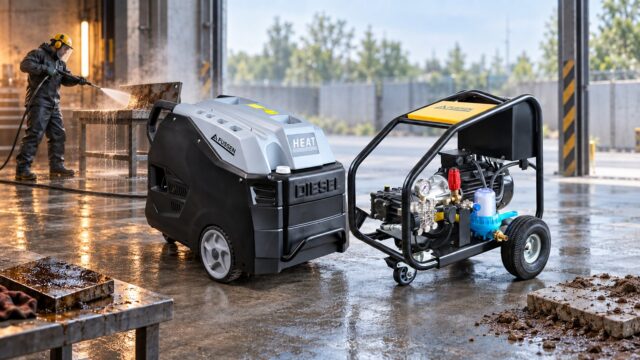
- A hot water washer needs diesel for the burner even if the pump is driven by an electric motor. Fussen’s FHE, FHP and FHS hot water series (200–250 bar, 15–18 L/min) are built this way, with an electric-drive pump and an oil-fired boiler.
- The burner produces combustion gas, so a hot water unit needs ventilation or a flue even indoors, although far less than an engine.
- The pump head should be rated for the temperature. Stainless steel or nickel-plated manifolds with high-temperature seals are the right specification; a standard brass cold-water pump fed with 80 °C water will fail early.
Sizing rule of thumb: raising 15 L/min from 15 °C to 80 °C requires about 68 kW of burner output, which is why hot water washers carry burners of 60–100 kW and use around 5–8 liters of heating oil per hour at full temperature. The energy cost is real, but the reduction in cleaning time and chemical use normally covers it.
The decision sequence
Work through these questions in order. The first “yes” usually decides the drive.
- Will the machine ever be used indoors, in a confined space or in a hazardous (ATEX) zone? Yes → electric. Choose an EX-rated series for hazardous zones. Stop here.
- Is there a 400 V three-phase supply within about 50 m of every regular work location? Yes → electric. Size the motor with P ≈ bar × L/min ÷ 600 ÷ 0.88 and check the outlet rating (16 A ≈ 7.5 kW, 32 A ≈ 15 kW, 63 A ≈ 30 kW). Stop here.
- Is only single-phase 230 V available, and is the required duty at or below about 150 bar / 10 L/min? Yes → single-phase electric (FSE class). No, but the duty is higher → go to question 4.
- Is the required shaft power above about 25 kW, or will the machine run more than four hours a day, or does the rest of the fleet run on diesel? Yes → diesel. Choose FAD/FBD for 150–500 bar, FCD/FED for 350–1,000 bar, FKD for jetting above 700 bar.
- Otherwise → gasoline. Choose FAG/FBG for 150–350 bar, FCG/FDG for 300–500 bar.
- In every case: does the task involve grease, oil, fat or disinfection? Yes → add a hot water unit or specify a hot water series.
Applied to three real cases: a bottling plant wash-down (indoors, three-phase available) becomes an electric FAE or FBE, probably hot water; a highway maintenance crew (no power, diesel truck, six-hour shifts) becomes an FBD or FCD diesel; a mobile vehicle valeting contractor (van-based, two hours a day, 150–200 bar) becomes an FAG gasoline unit.
Tell Fussen’s engineering team where the machine will work, what power is available and how many hours a day it will run, via the contact page, and we will recommend the drive, the pressure class and the pump material for your application.
Frequently asked questions
Which is better, an electric or gas pressure washer, for industrial use?
Electric is better wherever mains power is available: lower running cost, lower noise, no exhaust, and it can be used indoors and in ATEX zones. Gasoline or diesel is better only when the machine must work away from a suitable power supply.
Can I use a gasoline or diesel pressure washer indoors?
No. Engine exhaust contains carbon monoxide and reaches dangerous concentrations quickly in enclosed spaces. Use an electric machine indoors; if heat is required, a hot water electric unit with a properly vented burner is acceptable.
How much power does a 400 V three-phase socket give me?
As a rule of thumb, 16 A supports about 7.5 kW, 32 A about 15 kW and 63 A about 30 kW, which corresponds to roughly 250 bar / 18 L/min, 350 bar / 21 L/min and 500 bar / 22 L/min respectively.
When should I choose diesel over gasoline?
Choose diesel when the machine will run more than about four hours a day, needs more than about 25 kW, or shares a vehicle with other diesel equipment. Choose gasoline for lighter, intermittent, van-based work below about 500 bar.
Does a hot water pressure washer need an engine?
No. Most hot water washers use an electric motor to drive the pump and a diesel-fired burner to heat the water. The burner needs fuel and ventilation, but the drive itself can be electric.
Need a recommendation?
Get a Quotation and Technical Recommendation Within 24 Hours
Send us your pressure, flow and application. Our engineers reply within 24 hours.

Fussen has designed and manufactured high pressure plunger pumps and industrial washers in Foshan, China since 2001. ISO 9001 / 14001 / 45001, CE and ATEX-certified, exporting to more than 60 countries.