Most high pressure pumps that come back for repair did not fail because of a design flaw. They failed because the inlet filter was never cleaned, the oil was two years old, the unit was started dry, or nobody noticed the weep port dripping until water reached the crankcase. Good high pressure pump maintenance is not complicated, but it has to be scheduled and it has to be understood: a plunger pump tells you what is wrong through pressure, pulsation, oil color and leaks, and each symptom points to a short list of causes. This guide gives a maintenance table you can copy into your plant schedule, the inlet and water quality rules that prevent the two most expensive failures, cavitation and dry running, and a symptom-to-fix table for the calls we hear most often: pressure washer pump losing pressure, pump pulsating, water in the oil, leaks at the head, overheating and noise. It ends with winterisation, a spare parts kit and the rule for deciding when to repair and when to replace.
High Pressure Pump Maintenance Schedule
The intervals below apply to triplex ceramic plunger pumps on clean water at rated pressure, which covers Fussen pumps from the 120 bar A series to the 2,000 bar E series and the washers built around them. Shorten intervals by a third for dirty water, water above 40 degrees Celsius, continuous three-shift operation or ambient temperatures above 40 degrees Celsius.
| Interval | Task | What to look for |
|---|---|---|
| Daily, before start | Check oil level at sight glass; check inlet filter; confirm water supply and prime | Oil between marks and clear, not milky; filter free of debris; water flows from the gun before pressure is applied |
| Daily, during run | Watch pressure gauge and listen | Steady needle, no knocking, no drip from weep port beyond a few drops per minute |
| Weekly | Clean Y strainer and inlet screen; inspect hoses, couplings and gun; check nozzle orifice | Cracks, bulges, worn quick couplers; nozzle wear shows as lower pressure at the same flow |
| First 50 hours | Change crankcase oil | Removes run-in particles from new bearings and crossheads |
| Every 500 hours or 3 months | Change crankcase oil; inspect valves; check belt tension or coupling | Valve seats without rings or pitting; plates flat; springs at free length |
| Every 1,000 hours or 6 months | Replace high and low pressure seals; inspect plungers; replace valve seats and plates if marked; check unloader and safety valve setting | Plungers unscored; unloader opens within 10 percent of set pressure |
| Every 2,000 hours or yearly | Full inspection including bearings, oil seals and crosshead clearance; calibrate gauge | Shaft end float within manufacturer tolerance; no oil at plunger slingers |
Two habits make this schedule work. Log running hours with an hour meter or by shift and record each service; without hours you will service too early or too late. And treat oil changes as non-negotiable: crankcase oil also carries heat away from the crossheads, and darkened or thinned oil does that job badly.
Oil specification and quantity
Use a non-detergent SAE 30 or ISO VG 100 mineral oil unless the manual specifies otherwise, or a synthetic gear oil of the same viscosity in hot climates. Fill to the center of the sight glass with the pump stopped; overfilling causes foaming and oil leaks at the seals.
Water Quality and Inlet Filtration
Water is the working fluid and the seal lubricant; anything suspended in it becomes an abrasive between plunger and seal lip.
- Filtration. Fit a Y strainer or inline filter at the pump inlet with a 50 to 100 micrometre element. Above 500 bar, or on any pump with valves smaller than 20 mm, tighten this to 50 micrometres or better. Clean it weekly and after every tank refill from an open source.
- Hardness. Water above about 300 mg/L as CaCO₃ leaves scale on valves and in the nozzle. Softening or periodic descaling with a mild citric acid solution keeps valve seats sealing.
- Chlorides. Seawater or brackish water attacks brass and nickel-plated brass heads. Specify a stainless steel head such as the FBS stainless steel plunger pump and flush with fresh water after each use.
- Temperature. Keep inlet water below 40 degrees Celsius for normal seals; 65 degrees Celsius is the absolute limit. Hot inlet water also raises the vapour pressure and makes cavitation far more likely.
- Chemicals. Inject detergents downstream of the pump where possible. If chemicals must pass through the pump, check compatibility of seals and head material, and flush with clean water for two minutes at the end of each shift.
Cavitation and Inlet Conditions
Cavitation is the most destructive thing that can happen to a plunger pump short of running it dry. When inlet pressure falls below the vapour pressure of the water, bubbles form on the suction stroke and collapse violently on the discharge stroke. The symptoms are a rattling or gravel noise, pressure fluctuation and, within days, pitted valve seats and cracked ceramic plungers.
A practical NPSH rule
Formal NPSH calculations exist, but a rule of thumb covers most pressure washer installations. The pump needs positive pressure at its inlet port of at least 0.2 bar, and preferably 1 to 3 bar, at full flow. To get there:
- Feed from a tank with the water level above the pump inlet, or from a mains supply that can deliver at least 1.3 times the pump’s rated flow at 1 bar or more.
- Size the suction hose so that water velocity stays below 1 m/s. In practice that means at least 19 mm inside diameter for pumps up to 20 L/min, 25 mm for 20 to 40 L/min, 32 mm for 40 to 80 L/min and 50 mm above that.
- Keep the suction hose short, under 5 m, with no loops, and no more than two elbows.
- Do not use a suction hose that can collapse under vacuum; use reinforced or hard-wall hose.
- Deduct 1 m of lift for every 0.1 bar you lose in a filter, and clean the filter before the loss exceeds 0.2 bar.
Break tank with float valve
The most reliable arrangement for a fixed installation is a break tank holding at least one minute of pump flow: a 30 L/min pump gets a 30 liter tank minimum, 100 liters is better. A float valve on the mains inlet keeps the tank full, the outlet to the pump sits 100 mm above the floor to leave room for sediment, and a low level switch cuts the motor before the pump can draw air. This isolates the pump from mains fluctuations, lets dissolved air escape and makes dry running almost impossible. Fussen recommends float-valve tanks for any washer that runs more than four hours a day.
Dry running
A ceramic plunger pump with no water has no seal lubrication. Within 20 to 30 seconds the seal lips overheat and glaze. Always prime by opening the gun, with the unloader in bypass or the pressure turned down, until air-free water flows, and only then bring the unit up to pressure. On engine-driven units such as the FCD diesel high pressure washer, prime before the engine is brought up to working speed.
Troubleshooting: Symptom, Cause and Fix
Work through the causes in the order listed, from most common and cheapest to check to least common. Look at the inlet side before opening the pump head.
| Symptom | Likely causes, in order | Fix |
|---|---|---|
| Low pressure, or pressure washer pump losing pressure over time | Worn or wrong nozzle; blocked inlet filter or insufficient supply; air leak on suction side; unloader bypassing; worn valves; worn seals | Fit new nozzle of correct size; clean filter and check supply flow; tighten suction fittings; reset or repair unloader; replace valve seats and plates; replace seals |
| Pump pulsating, gauge needle swinging | Air in suction line; one inlet valve stuck or not sealing; one cylinder not filling; damaged pulsation damper | Bleed and check fittings; remove and clean valves, replace worn pair; check inlet conditions; recharge or replace damper |
| Milky oil, water in crankcase | Worn low pressure seals allowing water past slinger; blocked weep drain; worn oil seal; condensation from short runs in cold weather | Replace low pressure seals; clear weep drain; replace oil seal; change oil, run to operating temperature |
| Water leak at pump head or weep port | High pressure seals worn; plunger scored; head bolts loose; O-ring on valve plug damaged | Replace seals and inspect plungers; replace scored plunger; torque head bolts to specification; replace O-rings |
| Pump or oil overheating | Running in bypass too long; low or old oil; belt slipping or coupling misaligned; blocked crankcase breather; ambient too high | Limit bypass to 3 minutes or fit a thermal relief valve; change oil; align and tension drive; clear breather; improve ventilation |
| Knocking or rattling noise | Cavitation from poor inlet; valve spring broken; bearing wear; loose coupling | Correct inlet conditions; replace valve cartridge; inspect bearings and end float; check coupling |
| Pressure will not build at all | Nozzle missing; unloader stuck open; safety valve open; belt broken; multiple valves stuck | Fit nozzle; free or replace unloader; reset safety valve; replace belt; clean or replace valves |
How to confirm a valve versus seal problem
Both cause low pressure, so a quick test saves time. Run the pump at low pressure with the gun open and measure flow by timing a bucket. If delivered flow is more than 10 percent below the nameplate value at the correct speed, the valves are the first suspect. If flow is correct but the weep port is streaming, the high pressure seals have gone. If flow is correct, the weep port is dry and pressure is still low, the fault is downstream: nozzle, unloader or a leaking hose.
Reading the unloader
The unloader valve diverts flow to bypass when the gun closes. A worn unloader seat lets water bypass with the gun open, which shows as low pressure that a new nozzle does not cure. Check the bypass line temperature: if it is warm while the gun is open, the unloader is passing. On units above 500 bar, such as the FDE 1,000 bar electric washer, a leaking unloader also causes rapid heating of the water in bypass, so repair it promptly.
Seal and Valve Replacement Procedure
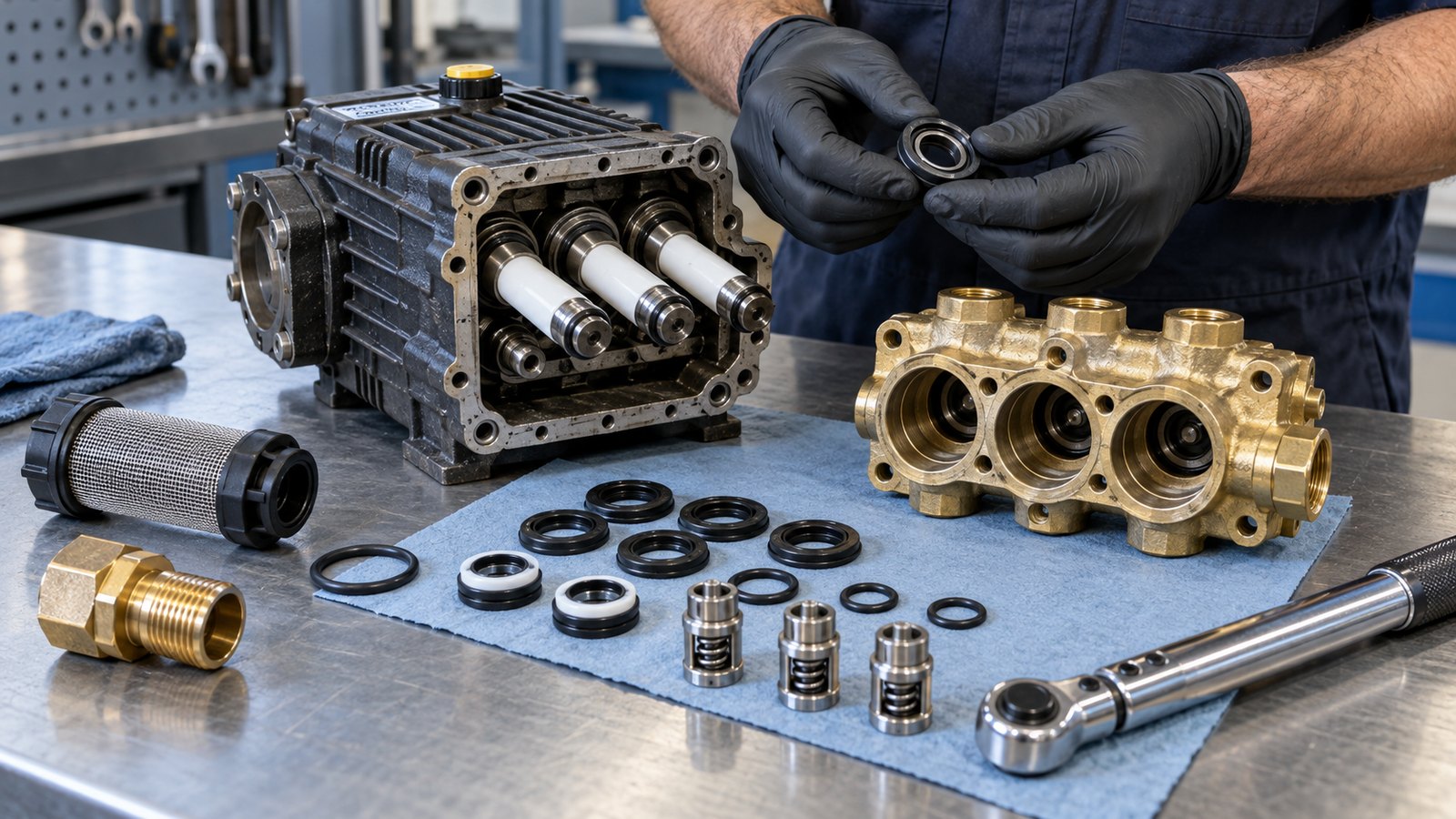
A seal change on an A, B or C series pump takes about one hour. The steps that decide whether the new seals last are the ones people skip.
- Isolate power, relieve pressure, drain and remove the head, keeping the plungers in place.
- Push the old seal packs out from the crankcase side, noting the orientation and order of every ring and support.
- Inspect each plunger under a light. Any scoring you can feel with a fingernail means the plunger must be replaced, or the new seals will fail within days.
- Clean the seal bores. Scale or debris left in the bore prevents the new seal from seating and causes a leak from the first start.
- Fit the new low pressure seals, then the high pressure seals, using the correct sleeve or a chamfered plunger end so the lips are not cut on the plunger edge. Lubricate with water-compatible grease only.
- Refit the head, tightening the bolts in a cross pattern in three stages to the specified torque.
- Replace valve cartridges as pairs of seat and plate; never lap a seat by hand and refit it.
- Prime, run at low pressure for five minutes, then bring up to working pressure and check the weep port.
Winterisation and Storage
Water expands about 9 percent when it freezes, which is enough to crack a brass head or a ceramic plunger. If the pump will sit below 0 degrees Celsius, do one of the following:
- Draw a 50:50 propylene glycol antifreeze solution through the pump from a bucket until it runs from the gun, then stop. This also protects the seals from drying out.
- Blow the pump through with compressed air at no more than 3 bar until dry. This is less reliable because pockets of water remain in valve cavities.
For storage of more than a month, additionally change the oil, disconnect the battery on engine units, cover inlet and outlet ports, turn the shaft by hand once a month to keep the bearings and seals from taking a set, and store indoors. Before returning to service, prime carefully and run for five minutes at low pressure to rewet the seals. Hot water units such as the FHE hot water high pressure washer also need the coil and burner circuit drained separately.
Spare Parts Kit for Each Pump
Downtime is normally not the repair but the wait for parts. A minimum on-site kit per pump, or per group of identical pumps, is:
- One complete set of high and low pressure seals with support rings and O-rings.
- One complete set of six valve cartridges, or seats, plates and springs.
- Head O-rings and valve plug O-rings.
- One plunger, or a full set of three for pumps above 500 bar where any plunger damage from cavitation tends to affect all three.
- Oil seals and one oil change.
- Inlet filter elements and a spare Y strainer screen.
- Nozzles in the working size plus one size up and one size down, so wear can be corrected immediately.
- Unloader repair kit and a spare pressure gauge.
- Drive belt where fitted.
Store elastomer parts in sealed bags away from sunlight and ozone sources such as electric motors. For fleets, hold one complete spare pump so a machine is back at work in the time it takes to swap it, and repair the removed unit on the bench.
Repair or Replace: A Decision Rule
Seals, valves, O-rings and plungers are consumables; replacing them is maintenance, not repair. The decision point comes when the crankcase side is involved.
| Condition | Recommendation |
|---|---|
| Worn seals, valves or one plunger; crankcase clean and quiet | Repair on site with kit parts |
| Scored plungers plus water in oil, bearings still quiet | Repair: plungers, all seals, oil seals, oil change |
| Bearing noise or end float beyond tolerance, crankshaft undamaged | Workshop repair: bearings, oil seals, check crosshead bores |
| Cracked head, corroded valve bores or crankshaft damage | Replace pump; parts and labour exceed 60 percent of a new unit |
| Pump over 8,000 hours with two or more major repairs | Replace; repeated failures indicate accumulated wear in the crankcase |
As a rule, when the quoted repair exceeds 60 percent of the price of an equivalent new pump, replace it, and take the opportunity to correct whatever inlet or water quality issue caused the damage. Because Fussen pumps share mounting patterns within a series, a worn brass FAB series pump can be swapped for a nickel-plated FAN or stainless FAS unit in the same frame if the water has turned out to be harder or more corrosive than expected.
For a service manual, seal kit or replacement pump, contact Fussen with the pump model and serial number. Our engineers can also review your inlet arrangement and water analysis before the next failure.
Frequently asked questions
Why is my pressure washer pump losing pressure?
Check in this order: a worn or oversized nozzle, a blocked inlet filter or weak water supply, air leaking in on the suction side, an unloader valve bypassing with the gun open, then worn valves and finally worn seals. Measure delivered flow with a bucket and stopwatch; if it is more than 10 percent below nameplate, the valves or seals are the cause, otherwise the fault is downstream of the pump.
What causes a high pressure pump to pulsate?
Pulsation beyond the normal ripple of a triplex pump almost always means one cylinder is not doing its share. The usual reasons are air entering the suction line, an inlet valve that is stuck or not sealing, or a cylinder that is not filling because the inlet is restricted. Bleed the suction line, check the fittings, then remove and inspect the valves. A damaged pulsation damper produces the same symptom.
How often should I change the oil in a plunger pump?
Change the first fill after 50 hours to remove run-in particles, then every 500 hours or every 3 months, whichever comes first. Use a non-detergent SAE 30 or ISO VG 100 mineral oil, or an equivalent synthetic gear oil in hot climates, and change it immediately if it turns milky, which means water has entered the crankcase.
What inlet filter size does a high pressure pump need?
A 50 to 100 micrometre Y strainer or inline filter at the pump inlet is standard for pumps up to 500 bar. Above 500 bar, use 50 micrometres or finer. Clean the element weekly and whenever the inlet pressure drop exceeds about 0.2 bar, because a blocked filter starves the pump and causes cavitation.
How do I protect a high pressure pump from freezing?
Draw a 50:50 propylene glycol antifreeze solution through the pump until it flows from the gun, then stop and leave it in place. Blowing the pump out with compressed air at 3 bar or less is a second option but can leave water in the valve cavities. Store the unit indoors, and before restarting, prime and run at low pressure for five minutes to rewet the seals.
Need a recommendation?
Get a Quotation and Technical Recommendation Within 24 Hours
Send us your pressure, flow and application. Our engineers reply within 24 hours.

Fussen has designed and manufactured high pressure plunger pumps and industrial washers in Foshan, China since 2001. ISO 9001 / 14001 / 45001, CE and ATEX-certified, exporting to more than 60 countries.